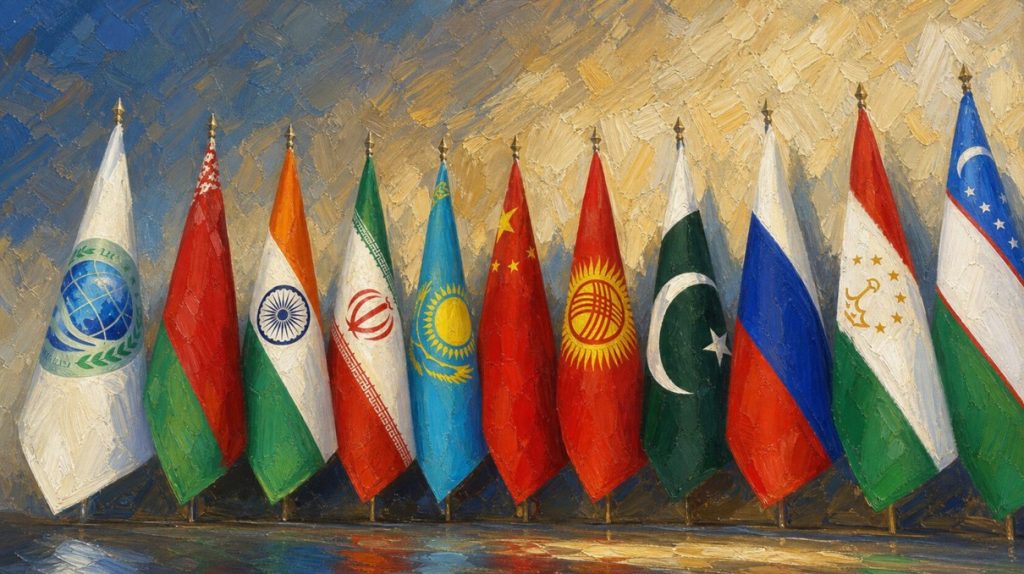
In 2026, the Shanghai Cooperation Organization marks the 25th anniversary of its establishment in 2001, when six Eurasian states – Kazakhstan, China, Russia, Kyrgyzstan, Tajikistan, and Uzbekistan – formalized a new format of interaction based on the Shanghai agreements of 1996-1997. Over a quarter of a century, the SCO has transformed into the largest regional organization, with ten member states (Belarus, India, Iran, Kazakhstan, China, Kyrgyzstan, Russia, Tajikistan, Pakistan, Uzbekistan) and a broad network of observers and dialogue partners.
At the SCO’s 25th anniversary summit in Tianjin, held from August 31 to September 1, 2025, PRC President Xi Jinping stated that “the Shanghai Cooperation Organization has become the world’s largest regional organization, bringing together 26 countries, cooperating in more than 50 areas, and having a combined economic output of nearly 30 trillion dollars.” This assessment reflects not only the scale of the SCO, but also the growing role of the “China-Central Asia” nexus, where Kazakhstan serves as a key hub.
Kazakhstan also occupies a special place in the history of the Belt and Road Initiative (BRI): it was in Astana in 2013 that Xi Jinping first proposed the concept of the Silk Road Economic Belt, which became the land-based dimension of the BRI. This initially positioned Kazakhstan as a country that simultaneously shapes the SCO agenda and serves as the BRI’s “launch pad.”
The development of the SCO has gone through several key stages. First, at the initial stage, the central task was to strengthen trust in border areas, demilitarization, and joint efforts against the “three forces”: terrorism, separatism, and extremism. Kazakhstan and China, having completed the delimitation and demarcation of their border, used the SCO as a framework to consolidate this trust and elevate relations to the level of a strategic partnership.
Second, as the agenda expanded, the organization moved from a narrow focus on security issues to a comprehensive “security plus development” agenda, in which economic, energy, transport, and humanitarian cooperation became equal pillars. Kazakhstan consistently promoted the idea of linking the SCO agenda with the tasks of sustainable development, diversification, and infrastructure connectivity.
Third, in 2024-2025, Kazakhstan’s role within the SCO significantly strengthened. At the summit in Astana on July 4, 2024, President of Kazakhstan K.-J. Tokayev announced Belarus’s accession as the tenth member state, which completed an important stage of expansion and confirmed Kazakhstan’s status as the organization’s “entry point.” At the 2025 Tianjin summit, Kazakhstan emerged as one of the key architects of the SCO’s future architecture.
Speaking at the meeting of the Council of Heads of State of the SCO in Tianjin on September 1, 2025, President of Kazakhstan K.-J. Tokayev emphasized:
“In the context of escalating geopolitical conflicts, technological rivalry, financial and economic sanctions, environmental and man-made disasters, the SCO must become a permanently functioning platform for establishing broad political interaction, strengthening mutual trust in the international community, developing humanitarian cooperation, and fostering inter-civilizational dialogue.”
This formula well reflects the Kazakh approach: to use the SCO as an instrument not only of regional, but also of broader Eurasian stability.
A key element of this transformation was the alignment of China’s BRI with Kazakhstan’s national program “Nurly Zhol” (2015-2019). Their synchronization made it possible to create a unified strategic framework in which external investment flows and internal development priorities do not compete, but rather reinforce one another. This ensured accelerated modernization of transport and logistics infrastructure and created a basis for deeper industrial cooperation.
Today, the practical results of this linkage are already evident. Kazakhstan has strengthened its position as one of Eurasia’s leading transit hubs, significantly upgraded its infrastructure base, and attracted substantial investment. However, it is equally important that this integration model is embedded in the long-term national development strategy. In his Address to the People of Kazakhstan on September 2, 2024, President Kassym-Jomart Tokayev explicitly linked the Belt and Road Initiative with the tasks of strengthening transit potential and deepening integration into the global economy, stressing that the development of transport and logistics infrastructure should become one of the key factors of sustainable growth: “The Belt and Road Initiative opens up enormous opportunities for us to strengthen Kazakhstan’s transit potential and integrate into the global economy. We will continue to actively develop transport and logistics infrastructure, which will be the key to our country’s prosperity.”
Thus, Kazakhstan’s participation in the BRI should be viewed not as an externally imposed direction, but as a conscious element of the country’s strategy for positioning itself in the new Eurasian architecture. In the context of the transformation of global supply chains and the growing importance of continental routes, Kazakhstan has the opportunity to secure for itself the role not only of a transit center, but also of a production and logistics hub capable of influencing the configuration of regional and interregional ties.
3-1.Trade and investment: reaching a new level
According to the General Administration of Customs of the PRC, in 2024 trade between China and Kazakhstan reached USD 43.82 billion, up 6.8% compared with 2023. In January-November 2025, bilateral trade amounted to USD 43.8 billion, 9.3% higher than in the same period of the previous year; China’s exports to Kazakhstan reached USD 26.5 billion, while imports from Kazakhstan totaled USD 17.3 billion (an increase of almost 18.8%).
These figures indicate that Kazakh-Chinese trade and economic interaction has reached a qualitatively new level. In effect, this is about consolidating a stable bilateral trade “plateau” at above USD 43-45 billion, reflecting not a one-time spike, but the formation of a stable and predictable exchange dynamic. At the same time, imports from Kazakhstan into China are steadily growing, which is of fundamental importance from the standpoint of balancing the trade structure and gradually moving away from a raw-material model toward deeper integration into value chains.
At the same time, it is necessary to take into account methodological discrepancies in Chinese and Kazakh statistics, which traditionally lead to differences in estimates of total turnover. Nevertheless, most analytical reviews agree that by the end of 2025 the volume of bilateral trade had in fact approached the USD 45-50 billion range. In this context, China is consolidating its position among Kazakhstan’s largest trading partners, playing a system-forming role in its foreign economic structure.
The investment dimension complements this picture and reinforces the strategic nature of the interaction. China remains one of the key sources of capital for Kazakhstan, above all in infrastructure projects, energy, the mining and metallurgical complex, and manufacturing. Importantly, a significant share of these investments is implemented within the broader logic of aligning the Belt and Road Initiative with SCO mechanisms, which gives them not only economic but also geoeconomic significance.
3-2.Transport and–logistics integration
In the transport sphere, cooperation between Kazakhstan and China within the BRI and the SCO has produced the most tangible and measurable results. It is here that the integration of strategies has moved to the level of practical implementation, forming a new configuration of Eurasian transport. Over recent years, the two sides have consistently invested in the construction and modernization of key sections of transit infrastructure. This includes railway lines, highways, and logistics hubs, including dry ports such as Khorgos. As a result, a stable flow of freight traffic between China and Europe has been established through Kazakhstan’s territory, cementing the country’s status as one of the continent’s central transit links.
The next stage has been the expansion of route geography and flexibility. Kazakhstan is actively promoting the alignment of Chinese transport corridors with the Trans-Caspian International Transport Route, known as the Middle Corridor. This route, passing through the Caspian Sea and the South Caucasus, makes it possible to diversify delivery routes and reduce dependence on individual directions. In the context of growing geopolitical turbulence, such multi-vectority becomes not merely an advantage, but a necessary element of the resilience of the entire logistics system.
Energy cooperation complements transport integration and enhances its strategic significance. Existing oil and gas pipelines toward China ensure stable supply volumes, forming a long-term basis for energy interaction. At the same time, new projects are already being considered in light of the global energy transition, which opens up opportunities to expand cooperation in processing, improving energy efficiency, and developing more environmentally friendly technologies.
The cumulative effect of these processes goes beyond infrastructure changes. According to Chinese and international experts, if the current pace of transport system development is maintained, the BRI could increase Kazakhstan’s gross domestic product by up to 21%. The main drivers of such growth are linked to increased transit revenues, the development of industry along transport corridors, and the strengthening of the country’s role as one of Eurasia’s key logistics centers. In this sense, transport integration becomes not only an instrument of foreign economic policy, but also a factor in the internal structural transformation of the economy.
3-3.Energy and green transformation
Kazakh-Chinese interaction is gradually moving beyond the traditional raw-material model and toward a more complex structure of cooperation focused on technological renewal and sustainable development. At the center of this transition are projects in green energy, energy efficiency, and the introduction of low-carbon solutions, which correspond both to Kazakhstan’s long-term priorities and to China’s strategic orientation toward the development of an environmentally focused economy.
The practical content of this agenda is taking shape in several key areas. First, it involves the modernization of existing energy facilities and infrastructure using Chinese technologies, which makes it possible not only to improve efficiency but also to reduce the carbon burden on the economy. Second, cooperation is developing in the field of renewable energy sources and green hydrogen production projects, which are seen as part of Kazakhstan’s long-term low-carbon strategy and a potential niche for entering new markets. Third, the role of financial instruments oriented toward sustainable development is increasing, including the participation of Chinese banks and investment funds specializing in green projects.
Taken together, these processes create an opportunity for Kazakhstan not only to diversify its energy sector, but also to strengthen its positioning as a regional center of sustainable energy. Within the SCO, this creates an additional dimension of cooperation, where issues of economic growth begin to be directly linked with the environmental agenda and the requirements of the global energy transition.
3-4.Humanitarian and expert ties
The humanitarian dimension of Kazakh-Chinese interaction is gradually becoming increasingly systematic and is beginning to play the role of a long-term stabilizing factor. Unlike infrastructure and energy projects, which are oriented toward material results, it is the humanitarian agenda that forms a sustainable basis for reproducing the partnership in the future.
A key element here is the development of educational cooperation and academic mobility. The number of joint educational programs is expanding, the number of scholarships for Kazakh students at Chinese universities is increasing, and institutional ties between universities are strengthening. This creates a new generation of specialists oriented toward bilateral interaction and capable of working within the logic of integrating economies and scientific systems.
At the same time, the role of expert dialogue and so-called “track two” diplomacy is strengthening. In Kazakhstan and the countries of Central Asia, research centers studying China are actively developing, analytical platforms are being formed, and joint projects devoted to the SCO and the Belt and Road Initiative are being launched. Through these mechanisms, not only is knowledge exchanged, but coordinated approaches to key regional issues are also being developed.
As a result, what can be conditionally called a “human infrastructure layer” is taking shape. This refers to a network of professional, academic, and expert ties that ensure the depth and resilience of the partnership regardless of fluctuations in the political or economic environment. It is precisely this layer that, in the long term, determines the quality of interaction and its ability to adapt to new challenges.
China and Kazakhstan view the SCO as a key political and institutional framework in the field of security, within which their bilateral cooperation acquires a broader regional dimension.
At the 2025 Tianjin summit, Xi Jinping, opening the meeting of the Council of Heads of State, noted that the SCO had “become the world’s largest regional organization,” emphasizing not only the quantitative but also the qualitative growth of its influence.
For his part, K.-J. Tokayev, speaking at the same meeting, described the SCO as an “effective, influential, and in-demand international structure,” and stressed that Kazakhstan “fully supports the SCO’s key goals: an equal multipolar world order, security and stability, non-interference in internal affairs, and fair international trade.”
These statements demonstrate a convergence of approaches: China and Kazakhstan see the SCO as a pillar of multipolarity, a rejection of bloc logic, and a platform for “security through development.”
4-1.Security and strategic resilience
Kazakhstan and China build cooperation in the field of security primarily through multilateral mechanisms, using SCO instruments as the main coordination platform. Practical cooperation includes participation in the RATS counterterrorism track, as well as regular joint exercises and trainings in which scenarios for protecting critical infrastructure and transport corridors are rehearsed.
For Astana, such a model has practical significance. It makes it possible to reduce the risks of cross-border threats while simultaneously increasing the resilience of infrastructure linked to the Belt and Road Initiative. Equally important, reliance on a multilateral format makes it possible to maintain a balance in the security sphere and avoid the direct militarization of the region, which would inevitably intensify if the shift were made toward rigid bilateral military-political alliances.
4-2.Economic connectivity and regional resilience
Infrastructure, logistics, and energy projects implemented within the BRI on Kazakhstan’s territory create a pronounced stabilizing effect for the entire Central Asian region. Their development leads to the diversification of export and transit routes, reducing dependence on individual directions and increasing the overall resilience of foreign economic ties. At the same time, the interconnectedness of the region’s states is strengthening, and a denser network of transport and economic interactions is being formed, which objectively complicates scenarios of confrontation.
Equally important is the formation of mutual interests in the spheres of economy, logistics, and energy. As such ties deepen, the cost of destabilization rises, since any conflicts begin to directly affect shared infrastructure and investment projects.
In this configuration, Kazakhstan acts as a key intersection point of interests, linking China, Russia, the Caspian region, the South Caucasus, and the European direction. This position strengthens its bargaining power and expands opportunities for mediation, allowing it to flexibly balance between different centers of power.
The most important achievements at the current stage can be grouped into several interrelated blocks with both quantitative and qualitative dimensions.
First, trade and economic relations have been brought to a fundamentally new level. Bilateral trade has reached a stable plateau of over USD 43-45 billion, and in January-November 2025 growth amounted to about 9-10% compared with the previous period, while imports of Kazakh products into China increased by almost one-fifth. This indicates not only the expansion of mutual trade, but also the gradual correction of imbalances in its structure through a more active presence of Kazakh goods in the Chinese market. The expansion of supplies of Kazakh uranium and metal products is a telling example: thanks to the modernization of the contractual base and logistics, these have become among the drivers of export growth to China, enabling Kazakhstan to consolidate its status as a reliable supplier of strategic raw materials and increase its role in global value chains.
Second, Kazakhstan’s structuring as a key transit hub of Eurasia is being consolidated. Joint efforts integrate the country’s territory into the system of Eurasian corridors as a “supporting bridge” between China, Russia, the Caspian region, and Europe. The modernization of railway and road networks, the launch and development of dry ports, and alignment with the Middle Corridor and Caspian routes create an effect of “linking continents.” Thus, the development of the Khorgos – Eastern Gate dry port has turned it into one of the key transit hubs on the Kazakhstan-China border, through which China–Europe container trains pass. This not only speeds up cargo delivery and increases Kazakhstan’s transit revenues, but also secures its role as an indispensable link in Eurasian logistics.
Third, energy and “green” partnership is noticeably deepening. The long-term operation of the Kazakhstan-China oil and gas infrastructure ensures predictability of export flows and makes energy cooperation a core element of the bilateral agenda. On this foundation, the two sides are beginning to build a new dimension – joint projects in renewable energy and low-carbon technologies, which fit into Kazakhstan’s climate commitments and China’s long-term strategies. A telling example here is the pilot construction of solar and wind power plants with the participation of Chinese companies in regions of Kazakhstan with high renewable energy potential: they demonstrate a shift from the classic raw-material model to the joint creation of a “green” energy infrastructure oriented not only toward raw-material exports, but also toward sustainable domestic development.
Fourth, cooperation is being institutionalized within multilateral frameworks, which takes the bilateral agenda beyond simple one-on-one cooperation. The adoption at the Tianjin summit of the SCO Development Strategy until 2035 and a package of decisions to strengthen the organization’s institutions creates a normative and political space in which Chinese-Kazakh initiatives gain additional legitimacy and resilience. Against this backdrop, Kazakhstan is consolidating its role as one of the SCO’s main “idea donors,” promoting proposals to create specialized centers – on water resources, artificial intelligence, and inter-civilizational dialogue. For example, Astana’s initiative to establish a specialized SCO center for water resources management in Central Asia reflects Kazakhstan’s desire not only to solve its own problems, but also to offer collective solutions for the entire region, relying on the potential of Chinese technologies and investment.
Finally, fifth, a stable humanitarian and expert environment is taking shape, without which neither infrastructure nor trade projects would be viable in the long term. The expansion of academic exchanges, joint programs, and research projects creates the “human foundation” of the partnership, while the growth of specialized analytical platforms and media outlets helps закрепить the image of positive interdependence in public opinion. A telling example is the work of Kazakh and Chinese research centers on SCO and Belt and Road topics, where joint reports and expert forums in Astana and Beijing begin to have a real impact on shaping the agenda of summits and ministerial meetings. This indicates a transition from episodic humanitarian actions to the formation of a stable, self-reproducing layer of expert diplomacy that supports political and economic agreements.
Further development of interaction between Kazakhstan, China, and SCO partners should logically be considered through the prism of five interrelated areas: infrastructure and logistics development, quality investment and industrialization, green energy and the climate agenda, security and cyber resilience, as well as human capital and expert diplomacy.
6-1.Logistics and digital corridors
First, the priority should be to закрепить Kazakhstan’s status as a key land-sea link of the Middle Corridor. To this end, it is necessary to accelerate the development of sections that directly connect Chinese routes with the Trans-Caspian International Transport Route: the ports of Aktau and Kuryk, and railway and road lines toward the Caucasus and the Black Sea. The comprehensive plan for the development of maritime infrastructure until 2028 already envisages turning Aktau and Kuryk into a unified transport and logistics cluster, with a 50% increase in port throughput and a threefold increase in container capacity. On this basis, Kazakhstan should deliberately position itself as the “route of first choice” for Chinese and international shippers oriented toward Europe and the Middle East.
Secondly, the physical expansion of capacity must be accompanied by the creation of a full-fledged digital infrastructure for the corridors. It would make sense for Kazakhstan to initiate within the SCO the launch of pilot “digital corridors” with unified electronic document flow, end-to-end cargo tracking systems, and common risk management mechanisms on the Kazakh-Chinese border. In practical terms, this implies integrating national “single window” platforms, synchronizing customs procedures, and introducing joint IT solutions at key crossings, above all Khorgos and Dostyk. For Kazakhstan, this is an opportunity not merely to speed up transit, but also to become a testing ground for SCO digital solutions in logistics.
6-2. Quality Investments and Industrialization
The next block of recommendations is linked to the shift from quantitative growth to the quality of economic interaction. It is important to deliberately shift priorities from a raw-material model to processing and technology. When attracting Chinese investment, preference should be given to projects in deep processing of raw materials, agro-processing, mechanical engineering, the chemical industry, and “green” technologies, where high added value is created within the country. In agreements with investors, requirements for local production, technology transfer, and workforce training must be clearly enshrined – through commitments on local content levels, joint R&D, and the involvement of Kazakh universities and research institutes.
At the same time, it is advisable to develop joint industrial-logistics clusters at key nodes of transport corridors (Astana, Almaty, Shymkent, and the port zones of Aktau and Kuryk), oriented toward the SCO, the Middle East, and the EU markets. In this context, it is important to actively use decisions on creating an SCO Development Bank and launching the organization’s own payment and settlement infrastructure. New SCO financial instruments can become a source of long-term financing for joint Kazakh-Chinese projects with high added value.
6-3. Energy, Climate, and the “Green SCO”
The third block concerns the energy and climate agenda. Kazakhstan and China need to move from viewing green projects as an additional direction to integrating sustainable development into the core of bilateral cooperation. In practical terms, this means using the SCO track to develop coordinated approaches to implementing the Paris Agreement, carbon regulation, and a “green” taxonomy tailored to the specifics of Eurasia.
At the same time, Kazakh-Chinese projects in renewable energy, energy storage, and hydrogen energy should be elevated to flagship status for the entire SCO space. Kazakhstan, with its significant wind and solar generation potential, can offer pilot sites for joint projects that will serve as a showcase for the organization’s green transformation. In parallel, it is necessary to systematically integrate the assessment of climate and natural risks (drought, floods, land degradation) into the design and modernization of BRI corridors on the territory of the Republic of Kazakhstan, in order to avoid the effects of “infrastructure vulnerable to climate.” A logical step would be an initiative to create within the SCO a specialized infrastructure resilience center based on Kazakh research institutes and universities, mandated to develop methodologies and practical recommendations for member states.
6-4. Security, Cyber Resilience, and Trust
The fourth direction is linked to the fact that growing interconnectedness automatically raises security requirements, especially digital ones. The SCO should elevate the protection of critically important digital infrastructure for logistics and energy to the organization’s agenda, proposing concrete steps to develop common cybersecurity standards, exchange information on cyber threats, and train specialists. An important resource here will be the Universal Center for Countering Security Challenges and Threats being established in Tashkent and the Information Security Center being formed within it, intended to coordinate SCO countries’ work on cyber defense. Kazakhstan would do well to seek the role of one of the center’s key partners, focusing on the protection of transport and energy systems critical to the BRI.
At the same time, it is necessary to continue and strengthen classical counterterrorism cooperation through the SCO RATS, paying special attention to monitoring transnational networks and illicit flows that may use the “Belt and Road” infrastructure, from drug trafficking to weapons. For Kazakhstan, this is not only a matter of internal security, but also of maintaining trust in its transit corridors on the part of partners.
6-5. Human Capital and Expert Diplomacy
Finally, the fifth direction is the development of human capital and a sustainable expert environment as a condition for the long-term resilience of the entire cooperation complex. Thus, it is necessary to consistently expand the range of joint educational programs with Chinese universities in logistics, economics, energy, digital technologies, and international relations, using both bilateral mechanisms and SCO formats. An important task is to involve leading Kazakh universities and research institutes in research consortia and projects related to the SCO and the BRI, so that national expertise is embedded in the decision-making process rather than serving it after the fact.
At the same time, it makes sense to give expert and business dialogue a sustainable institutional form. Institutionalizing an annual Kazakh-Chinese forum on the BRI and SCO in Astana in the format “SCO + Central Asia + China” would make it possible to закрепить for Kazakhstan the status of a key platform for discussing the long-term architecture of Eurasian integration. At the same time, it is necessary to support and develop a network of think tanks capable of generating applied recommendations for governments and business, translating political declarations into concrete roadmaps and project portfolios.
By the 25th anniversary of the SCO, Chinese-Kazakh cooperation within the framework of the “Belt and Road” initiative had formed as one of the main pillars of Eurasian integration. Kazakhstan, being the country where the BRI initiative was put forward and one of the founders of the SCO, has managed to secure for itself the role of a key transit hub, a reliable political partner, and a generator of new integration ideas.
In the current conditions, it is precisely the combination of the SCO’s multilateral framework and the practice-oriented projects of the BRI that creates a unique window of opportunity for Kazakhstan. With the proper use of these tools, through prioritizing quality investments, green development, digitalization, and strengthening human capital, Astana can not only enhance its own sovereignty and resilience, but also make a systemic contribution to the formation of a sustainable, interconnected, and multipolar Eurasia.
China Studies Center