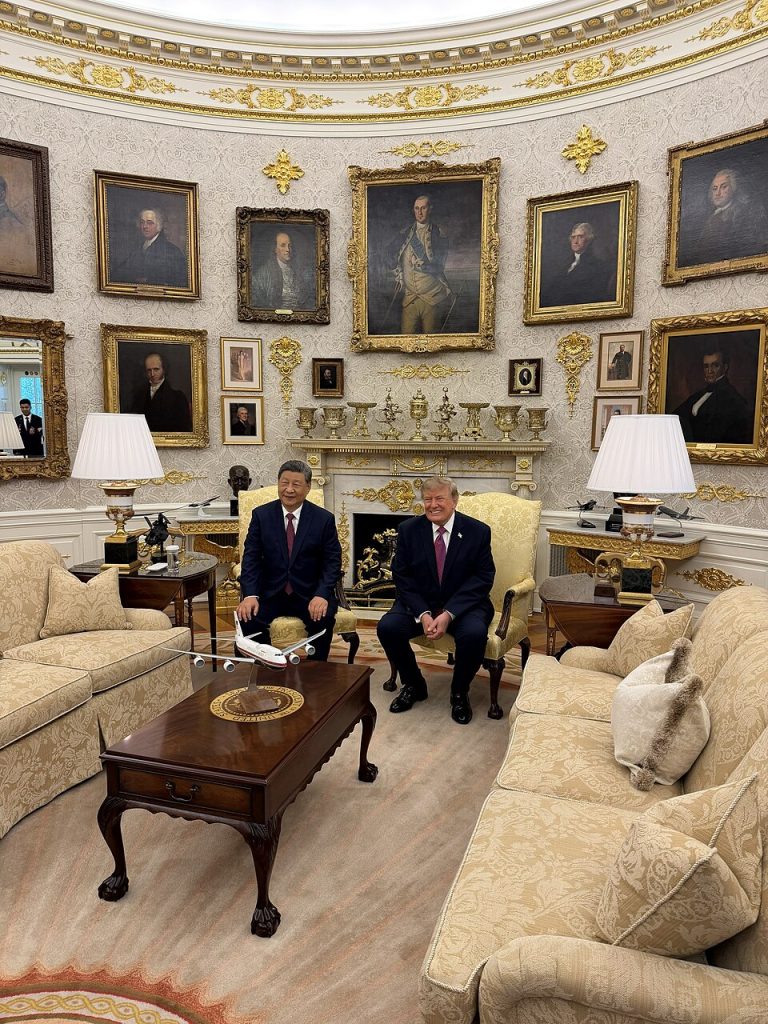
The state visit of Chinese President Xi Jinping to the United States, taking place from September 23 to 25, is attracting attention primarily because of the talks between the two leaders and major political issues. On September 24, Xi Jinping and U.S. President Donald Trump held talks at the White House. In less than half a year, reciprocal state visits by the heads of the two countries took place: in May, Donald Trump visited China, and now the Chinese leader is in Washington. The Chinese side calls such an intensity of contacts unprecedented in the history of bilateral relations.
However, the current visit is interesting for another reason as well. Alongside trade, artificial intelligence, security issues, and the international agenda, the human dimension of Chinese-American relations occupies a noticeable place in it.
This makes it possible to pose a broader question: to what extent does the stability of relations between the two largest powers depend not only on the ability of their leaders to reach agreements, but also on the existence of ties between societies, universities, regions, business, and youth?
For Kazakhstan, this question is also of interest. The experience of interaction between major powers shows that relations become significantly more stable when political dialogue is supported by an extensive system of practical and public contacts.
The talks confirmed the complex nature of the relationship
The meeting held on September 24 once again showed a characteristic feature of current Chinese-American relations: competition and cooperation exist simultaneously.
According to the official statement of the Chinese Foreign Ministry, the sides discussed trade and economic cooperation, artificial intelligence, Taiwan, as well as international and regional issues, including the Middle East, the Ukrainian crisis, and the Korean Peninsula. Xi Jinping once again outlined the Chinese approach to “constructive strategic stability,” which assumes that cooperation should remain the main direction of the relationship, competition should be kept within certain limits, and disagreements should be managed in such a way that they do not escalate into conflict.
The trade and economic agenda remains one of the most concrete areas of negotiation. According to U.S. Treasury Secretary Scott Bessent, the sides agreed to extend the current trade truce for another two months. At the same time, this is still more additional time for negotiations than a final settlement of accumulated trade issues. Unresolved topics include tariffs, purchases of American products, rare earth materials, and technological restrictions.
The discussion of artificial intelligence is also noteworthy. The Chinese side proposed continuing bilateral dialogue on the benefits and risks of AI, preventing its misuse, and preserving human control over the technology. Donald Trump, according to the official Chinese statement, also supported continued dialogue and cooperation in this area.
Thus, the talks did not eliminate fundamental disagreements. However, they confirmed the possibility of separating different levels of the relationship: competing in strategic technologies, discussing sensitive political issues, and at the same time preserving channels of practical interaction.
It is precisely this multilayered nature that is becoming one of the main characteristics of the modern model of Chinese-American relations.
Public ties are becoming part of the strategic agenda
Against this backdrop, it is especially notable that one of the prominent announcements of the current visit was a new initiative regarding youth.
During the ceremony at the White House on September 24, Xi Jinping announced a new initiative to invite 100,000 young Americans to China for exchanges and study over the next five years. This program in fact continues the “50,000 in five years” initiative announced in San Francisco in November 2023. According to the Chinese side, the initial goal was achieved two and a half years ahead of schedule.
The scale of the new initiative itself shows that humanitarian contacts are seen by Beijing not as a secondary addition to diplomacy, but as one of the tools for long-term stabilization of relations.
Of course, educational programs will not solve the problems of tariffs, export controls, or Taiwan. But their function lies elsewhere.
Strategic rivalry usually strengthens the tendency to view another country primarily through the prism of threats, restrictions, and political disagreements. Direct contacts create a more complex picture. Students, teachers, entrepreneurs, and researchers gain the opportunity to form an understanding of another country not exclusively through the political news agenda, but through their own experience.
For relations between China and the United States, this is especially significant precisely because the competition between them is long-term in nature.
Interregional ties create an additional level of resilience
There is another level of interaction that often remains outside attention to relations between Washington and Beijing: cooperation between regions.
For decades, ties have developed between Chinese provinces and U.S. states, as well as between cities in the two countries, in trade, education, agriculture, culture, tourism, and environmental affairs. These contacts have a practical feature: they are much closer to the concrete interests of business, universities, and local communities than big geopolitics.
That is precisely why regional cooperation can continue even during periods of strained interstate relations.
This year, the China-California trade and economic forum, a sister-cities conference, and interregional dialogues involving representatives of agriculture, industry, logistics, and other sectors were held. Such formats do not cancel political disagreements between the two states, but they sustain working ties where concrete mutual interests remain.
This experience is also of interest from the perspective of Central Asia. States’ external relations are increasingly no longer limited to contacts between national governments. Cities, regions, universities, research centers, and enterprises are gradually becoming independent participants in international cooperation.
For Kazakhstan, which is actively developing regional, educational, and expert ties simultaneously with different international partners, this level of diplomacy is becoming increasingly important.
Symbolic elements of the visit also matter
Some elements of the current visit’s program may at first glance appear purely ceremonial. However, in diplomacy, symbolic actions often help reveal a broader political design.
On September 24, Peng Liyuan and U.S. First Lady Melania Trump visited the Smithsonian National Museum of Asian Art, where they viewed works reflecting the history of artistic ties between the United States and Asia, and met with American schoolchildren. The White House separately emphasized the cultural and educational dimension of this part of the program.
Xi Jinping also announced the imminent arrival of two giant pandas at the Atlanta Zoo, once again using one of the well-known symbols of Chinese public diplomacy.
Taken separately, these events do not change the strategic balance between the United States and China. But they show an effort to include not only talks about disagreements in the current visit, but also a positive public agenda.
This is especially telling against the backdrop of the fact that the political relations between the two countries remain complicated.
Why the human factor cannot be considered secondary
The history of Chinese-American relations shows that public contacts sometimes did indeed precede political changes.
In 1971, the so-called “ping-pong diplomacy,” which began with the visit of American athletes to China, became one of the symbolic harbingers of normalization of relations. The following year, the historic visit of President Richard Nixon to the PRC took place, and diplomatic relations between the two countries were established in 1979.
It would be an exaggeration to draw a direct analogy between the situation of the early 1970s and the current stage. Today, China and the United States are not in a state of diplomatic isolation from one another. Their economies, universities, and societies are linked much more closely.
But historical experience shows another pattern: interstate relations need channels of interaction that exist beyond the offices of leaders.
It is precisely such ties that create an additional reserve of resilience during periods of political crises.
The Kazakhstani view: multi-level diplomacy is becoming the norm
For Kazakhstan, the current visit is interesting precisely because of this combination of different levels of interaction.
China and the United States are simultaneously conducting tough negotiations on economic and technological issues, discussing strategically sensitive problems, and expanding humanitarian contacts. This is not a contradiction, but rather a reflection of the nature of modern international relations.
Serious disagreements may persist between major powers, but this does not necessarily mean the end of cooperation in all other areas.
For middle powers, such a model has practical significance.
Kazakhstan is interested in an international environment in which political disagreements do not automatically lead to the destruction of economic, scientific, educational, and public ties. It is precisely the preservation of different channels of interaction that allows states to pursue a multi-vector foreign policy and participate simultaneously in various formats of cooperation.
At the same time, it is important to understand the limitations of humanitarian diplomacy. It is not a substitute for political decisions. Youth exchange will not resolve a trade conflict, and university cooperation will not eliminate strategic disagreements.
But the reverse dependence is also obvious: relations based solely on interaction between governments and lacking a public foundation are much more vulnerable to political fluctuations.
Resilience is formed at several levels
Xi Jinping’s current visit to the United States shows that the sides are trying to work simultaneously at least on several levels.
At the highest political level, the leaders confirm the need to control competition and prevent it from escalating into confrontation. In the economy, negotiations on trade and market access continue. In the field of artificial intelligence, a separate dialogue is gradually taking shape on risks and rules of interaction. At the same time, youth, educational, cultural, and regional contacts are expanding.
None of these levels alone guarantees stable relations.
But together they create a denser system of interconnections, in which political complications in one area do not necessarily mean a full crisis of the entire structure.
As of September 25, the state visit is still ongoing, so it is premature to draw final conclusions about its results. The program provides for further events until the visit concludes.
However, the talks already held allow one preliminary conclusion to be drawn. The current stage of Chinese-American relations is gradually moving beyond the simple dilemma of “cooperation or competition.” In reality, both models exist simultaneously.
Therefore, the main task is not to eliminate competition as such, but to create a sufficiently resilient system of political, economic, and public ties that will allow the two countries to manage it without destroying the entire structure of relations.
For Kazakhstan and Central Asia, it is precisely this ability of major powers to combine rivalry with practical interaction that is of special importance. It preserves an international space in which cooperation remains possible even when the interests of leading centers of power do not always coincide.
Photo: Executive Office of the President of the United States / Public Domain
China Studies Center