International cooperation delivers sustainable results when financial resources, knowledge, and technology expand people’s opportunities. The new OECD guidance examines how to consistently integrate poverty and inequality reduction goals into the planning, financing, and evaluation of development programs. For Kazakhstan, certain provisions of the document are useful for understanding the social and territorial outcomes of economic partnership with China.
The volume of attracted investment, the number of facilities built, and trade growth make it possible to judge the scale of international cooperation. However, to understand its impact on development, other questions must also be answered. Which population groups gain new opportunities? How accessible do the services created become? Does the situation improve in territories that previously lagged behind? Do positive changes persist after external financing ends?
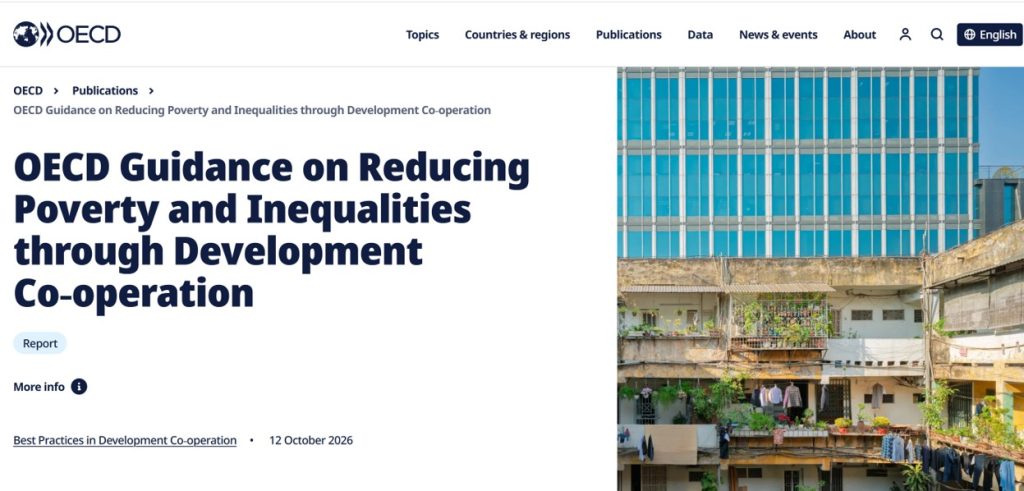
These questions are addressed in the guidance published on October 12, 2026, by the Organisation for Economic Co-operation and Development, OECD Guidance on Reducing Poverty and Inequalities through Development Co-operation. The 227-page document systematizes experience and recommendations on reducing poverty and inequality through development cooperation. It is based on four areas: strategic planning, allocation and mobilization of resources, equitable partnerships, and data, monitoring, and evaluation.
This is a practical guide for participants in international development cooperation. Its significance lies in connecting social goals with specific management decisions: from choosing priorities to verifying the results obtained. The document is not a special study of Kazakhstan, China, or the Belt and Road Initiative. Considering its approaches in relation to Kazakhstan-China partnership is a separate expert interpretation.
Poverty and inequality as interconnected tasks
The starting point of the guidance is that poverty and inequality must be considered together. Constraints in access to resources, rights, and opportunities affect people’s ability to improve their situation and cope with crises. Therefore, development support should take into account both the immediate needs of the population and the conditions that reproduce vulnerability.
For practical analysis, this means the need to look beyond average economic indicators. Growth in production or income may be accompanied by uneven changes for different social groups. People with in-demand qualifications use new opportunities faster, whereas residents of remote settlements, low-skilled workers, or small businesses may face additional barriers.
For example, the appearance of a large employer creates demand for labor, but local residents’ access to new vacancies depends on qualifications, transport accessibility, and hiring conditions. If these circumstances are not taken into account, the economic growth of a territory and the improvement in the situation of its population may proceed at different speeds.
Therefore, it is important to analyze who exactly can access the project’s results and what measures make it possible to broaden the circle of participants. In this logic, social issues become part of economic planning.
First direction: taking social outcomes into account in design
In the chapter on strategic planning, the OECD examines ways to incorporate poverty and inequality reduction goals into program design. It proposes taking into account the local context, possible distribution of outcomes, time horizons, and the relationship between immediate support and long-term change.
The practical significance of such an approach is especially visible at the project selection stage. It is not enough to determine which facility will be created and how much funding will be required. It is necessary in advance to establish what problem it solves, who will be able to benefit from its results, and what may hinder this.
In the case of an educational program, this means assessing whether graduates will be able to find jobs in their field. For an infrastructure facility, accessibility of connection and the cost of services are essential. For a business support program, the conditions under which small enterprises can obtain financing, information, and market access are important.
Such analysis helps avoid situations in which formally completed activities only partially solve the original problem. It also makes it possible to identify in advance contradictions between goals: for example, between the financial payback of a service and its affordability for low-income populations.
Second direction: assessing the quality of resource distribution
The financial section of the guidance covers concessional resources, domestic sources of financing, and private capital mobilization. Special attention is paid to how well financial instruments correspond to the goals of reducing poverty and inequality. When working with private investment, the quality of employment, affordability of goods and services, responsible business conduct, and environmental and social conditions are considered.
The point of this approach is a more precise understanding of the result of financing. A large volume of investment by itself does not show how the resulting benefits and obligations are distributed. Assessment requires information about service recipients, employment conditions, operating costs, and project sustainability.
At the same time, different financial instruments perform different functions. A commercial investor, a state budget, and an organization providing concessional financing operate under different conditions. Their participation should be coordinated so that the economic viability of the project is combined with the stated public goals.
For the recipient country, it is especially important to take subsequent costs into account. Construction of a facility creates an asset that then has to be maintained, serviced, and modernized. Therefore, assessment of the result should cover the entire period of its operation, including the burden on the budget and service users.
Third direction: the recipient side’s participation in decision-making
The guidance pays significant attention to the distribution of powers and influence between partners. The OECD examines obstacles arising from unequal financial and organizational capacities, as well as the importance of national systems, local priorities, and substantive participation by civil society organizations.
In practical terms, this raises the question of how much the recipient side participates in defining the goals of cooperation. Its role includes setting priorities, developing indicators, organizing implementation, and assessing consequences.
Local organizations possess knowledge that is difficult to obtain from general statistical data alone. They can identify labor market features, constraints on small businesses, the needs of individual settlements, and the reasons for low utilization of already created infrastructure.
The participation of such organizations makes sense when the information obtained influences decisions. Consultations should help adjust the project, clarify access conditions, and remove barriers. This requires a clear distribution of responsibility among government bodies, external partners, business, and other participants.
Fourth direction: turning data into decisions
In the section on data, monitoring, and evaluation, the guidance examines the ability of institutions to collect, analyze, and use information. Among the regional examples is World Bank support for the use of data in public administration in Central Asia. In Kyrgyzstan, more than 2,800 representatives of local authorities received training in working with a digital planning tool.
This example shows the importance of managerial competencies. The existence of a digital system does not yet guarantee that its data will be used in resource allocation. This requires trained specialists, comparable indicators, and procedures that link analysis with planning.
When evaluating international projects, it is useful to distinguish between completed activities and the changes they produced. The number of trained specialists reflects the program’s reach. Their subsequent employment and application of acquired skills make it possible to better understand the result. Similarly, commissioning a facility confirms completion of construction, while the accessibility and demand for its services characterize the subsequent return.
It is equally important to consider the initial situation. Without data collected before the project begins, it is difficult to assess the scale of change. At the same time, an improvement in indicators after launch does not yet prove that the project was the cause: national economic dynamics, migration, and other investments also affect the territory simultaneously.
The practical contribution of the guidance
The value of the document lies in systematizing tools that help consistently take poverty and inequality into account at different stages of cooperation. The OECD combines experience and recommendations on strategic and operational issues within the overall project cycle.
Therefore, it is more accurate to speak of the practical contribution of the guidance than of proof of a new universal relationship between investment and public welfare. It helps clarify the questions that need to be asked when designing and evaluating programs.
For the Kazakh expert community, the opportunity to link discussion of economic growth with analysis of the accessibility of its results is especially useful. This approach is applicable to various international partnerships, but it requires taking into account the specifics of each project, source of financing, and territory.
What this means for Kazakhstan-China cooperation
Kazakhstan-China relations create a broad field for such analysis. Following the talks between Kassym-Jomart Tokayev and Xi Jinping on June 16, 2025, 24 intergovernmental and interagency documents were signed, covering energy, digitalization, customs regulation, agriculture, science, and other areas. The meeting also noted the development of educational and scientific-technical cooperation, including Luban workshops and branches of Chinese universities.
In his speech at the Kazakhstan-China investment forum on September 25, 2026, the President of Kazakhstan outlined the prospect of moving toward full-fledged production ecosystems. He also noted the development of a network of logistics hubs from Lianyungang to Aktau and the importance of the Middle Corridor.
From Kazakhstan’s perspective, such an agenda requires attention to the links between individual areas of cooperation. A manufacturing enterprise, a transport terminal, and an educational program can reinforce the overall result if workforce needs, logistics, technology, and suppliers are aligned.
At the same time, commercial projects between Kazakhstan and China cannot automatically be assessed as development aid programs. Certain elements of the OECD approach are applicable: analysis of the distribution of benefits, accessibility of opportunities, participation of local organizations, and quality of data. Their adaptation should take into account contractual terms and the economic nature of the cooperation.
From transport accessibility to opportunities for businesses and residents
For Kazakhstan, transport links with China have independent economic significance. An additional question is how to use them to develop production and services within the country.
A company located near an international route does not necessarily gain simple access to the external market. It may need warehousing services, certification, packaging, working capital financing, and the ability to ship small batches of products. Therefore, the effect of a transport corridor also depends on how developed these supporting conditions are.
As an expert proposal for Kazakhstan, it is advisable to consider major logistics projects together with plans for the development of adjacent territories. Such plans could identify potential local suppliers, the need for vocational training, engineering infrastructure, and services for exporters.
A similar logic applies to industrial cooperation. What matters is the ability of Kazakh enterprises to fulfill orders, master new quality requirements, and gradually expand technological competencies. For this purpose, formal indicators of local participation are useful to supplement with an assessment of work actually performed within the country.
Which results are important to track
To assess the social and territorial effects of Kazakhstan-China projects, several interconnected areas can be proposed.
First of all, these are the quality of employment: permanent jobs after construction is completed, skill level, working conditions, and opportunities for professional growth. The next area is local suppliers: the sustainability of orders, the mastering of new production functions, and the value added created in Kazakhstan.
Technology and education deserve special attention. The result of joint training of personnel is reflected in the demand for graduates, while mastering equipment implies the development of competencies in its operation, repair, and adaptation.
Finally, changes for the territory must be taken into account: infrastructure accessibility, business development, pressure on water and energy supply, and environmental consequences. These indicators make it possible to see a fuller picture than reporting on a single enterprise.
The listed areas are a proposal for a national expert discussion. They are not presented in the OECD guidance as a special system for evaluating Kazakhstan-China projects.
Such work can begin with several pilot projects for which baseline data are available and the circle of participants is defined. Akimats, companies, universities, and analytical centers could agree on a limited set of indicators and evaluation timelines. The practical task is to obtain information that helps improve the project and its links with the regional economy.
For Kazakhstan, the OECD guidance is of interest as a source of approaches to a more precise assessment of the results of international cooperation. Its central theme, reducing poverty and inequality, encourages analysis of people’s access to economic opportunities and the conditions on which that access depends. Applying individual tools from the document may help better understand how investment affects employment, entrepreneurship, and territorial development.
In relations with China, such analysis can complement the long-term economic agenda. Aligning infrastructure projects with workforce training, supplier development, and regional needs creates conditions for more sustainable returns. This requires active participation by the Kazakh side in setting priorities, collecting data, and evaluating results, as well as joint work with Chinese partners to address identified constraints.
Kazakhstan’s strategic interest lies in expanding its own production and technological base, strengthening export opportunities, and improving the well-being of the population. It is through these results that the contribution of international projects to national development should be considered. In this context, Kazakhstan-China partnership acquires additional practical substance: the connections created help enterprises and residents of the country participate in economic growth and use its opportunities.
Main source: OECD Guidance on Reducing Poverty and Inequalities through Development Co-operation, OECD, October 12, 2026. The conclusions on applying individual approaches from the guidance to Kazakhstan-China cooperation are the author’s analytical interpretation.
China Studies Center