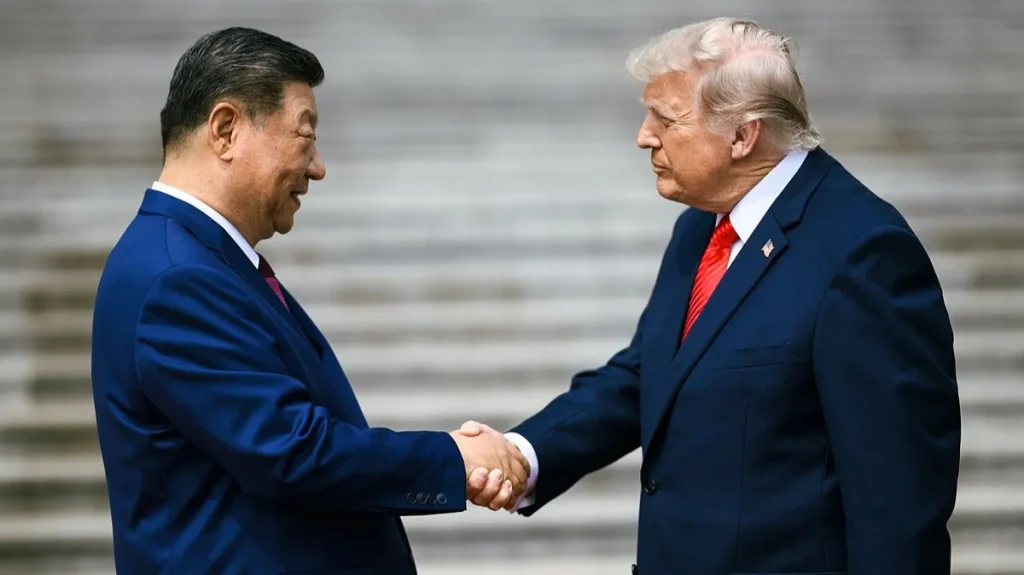
From September 23 to 25, President of the PRC Xi Jinping will pay a state visit to the United States at the invitation of U.S. President Donald Trump. The central event will be the official reception at the White House on September 24. This will be the second personal contact between the leaders of the two countries this year, following Donald Trump’s state visit to China in May.
The scale of attention to this meeting is explained not only by the weight of China and the United States in world politics. Today, the state of Chinese-American relations directly affects global trade, technology supply chains, investment flows, energy markets, the development of artificial intelligence, and international security. Therefore, for most other countries, the main question is not whether rivalry between Beijing and Washington will disappear. It will remain. Much more important is something else: whether the two largest powers will be able to keep this rivalry within politically manageable bounds.
It is precisely from this perspective that the upcoming visit is of particular interest to Kazakhstan.
After the meeting between Xi Jinping and Donald Trump in Beijing in May 2026, the formula of “constructive strategic stability” appeared in bilateral dialogue. In Chinese official materials, it is explained through four components: cooperation as the main direction, competition within reasonable limits, manageable differences, and the preservation of a long-term prospect of peace. In May, the Chinese side said that the leaders had agreed on this framework as a guide for relations in the coming years. In subsequent diplomatic contacts, representatives of both sides continued to refer to this formula. In the materials presented here, strengthening dialogue, managing differences, and increasing predictability are viewed as the central tasks of the current stage of Chinese-American relations.
It is important to understand that this is not about a return to the previous model of relations or the disappearance of strategic competition. Serious disagreements remain between the United States and China on trade, technology, security, and Taiwan. The Chinese side, in particular, continues to regard the Taiwan issue as one of the most sensitive areas of the bilateral agenda.
Therefore, the real indicator of the success of current diplomacy is not the absence of contradictions, but the ability not to let them escalate into an uncontrollable crisis.
In this sense, the significance of contacts between heads of state goes far beyond protocol. Relations between powers of such scale cannot be stabilized by a single meeting. However, decisions at the highest level can set the political framework within which trade, diplomatic, military, and expert mechanisms then begin to operate.
Over the past months, contacts between China and the United States have continued through foreign policy agencies, military security issues, trade and economic consultations, and interaction between expert and business circles. The initial set of reference materials draws attention precisely to the gradual transition from crisis response to a more institutionalized management of relations.
This is especially important because the cost of a sharp destabilization of Chinese-American relations давно ceased to be purely bilateral.
China and the United States are the world’s two largest economies, and their markets and production systems are deeply embedded in international value chains. Even changes in the tariff, technological, or investment policies of the two countries are quickly reflected in third countries. Therefore, the predictability of Chinese-American trade and economic relations becomes a factor of global economic stability. In the materials prepared ahead of the visit, this interconnection is formulated quite clearly: the more stable the economic ties between China and the United States are, the greater the degree of certainty for the global economy.
For Kazakhstan, this aspect has very practical significance.
China is one of our country’s largest trading partners. According to Kazakh statistics, Kazakhstan’s trade turnover with China in 2025 was about 34 billion dollars, while Chinese statistics recorded 48.7 billion dollars. In 2026, trade continued to grow. At the same time, Kazakhstan is developing an expanded strategic partnership with the United States in investment, technology, energy, critical minerals, transport, and other areas.
This fact clearly shows why stable relations between Washington and Beijing correspond above all to the practical logic of national development for Kazakhstan. Kazakhstan is not interested in turning economic, technological, and infrastructure ties into a system of mutually exclusive political choices.
For the states of Central Asia, the most favorable international environment is one in which cooperation with one major power does not limit the ability to interact with another.
This is especially noticeable in the transport sphere. Kazakhstan is becoming one of the key overland hubs between China, Central Asia, and European markets. According to Kazakhstan’s Ministry of Trade and Integration, about 85 percent of overland rail freight between China and Europe currently passes through Kazakhstan’s territory. At the same time, the country is developing the Trans-Caspian International Transport Route, border infrastructure, and logistics centers.
Therefore, the stability of global supply chains and the absence of excessive fragmentation of the world economy have direct economic significance for Kazakhstan. If U.S.-China competition leads to a large-scale division of markets, technological systems, and logistics chains, transit and trading states face additional costs. If, however, competition remains manageable, there is more room for the development of multilateral connectivity.
There is also a broader aspect. Chinese-American dialogue is increasingly addressing issues that cannot be effectively regulated solely at the national level. One such area is artificial intelligence. China and the United States occupy a central place in global technological competition, but at the same time, it is largely their interaction that determines the formation of international approaches to AI safety, the regulation of new technologies, and cross-border digital processes. In the source materials, the development of intergovernmental dialogue on artificial intelligence is directly considered one of the possible areas of practical cooperation between the two countries.
The same applies to international security. Even with different approaches from Beijing and Washington, direct communication channels between them reduce the risk of misinterpreting each other’s actions. For a world simultaneously facing several regional conflicts, such a function of dialogue in itself acquires significance.
The humanitarian dimension of relations deserves separate attention.
International politics is often analyzed almost exclusively through the competition of states. However, the stability of relations also depends on academic, youth, business, and interregional contacts. In recent years, China has actively developed exchange programs with American students and universities. The change in public sentiment in the United States is also noteworthy. According to a Chicago Council on Global Affairs poll conducted in July 2026 among 2,156 adult Americans, 57 percent of respondents supported friendly cooperation and engagement with China, while 40 percent would prefer a course of limiting the growth of Chinese influence. Support for engagement has increased compared with previous years, although significant political differences remain within American society. These data are also reflected in the provided selection.
Such a shift should not be interpreted as the disappearance of mutual distrust. Rather, it shows that part of society is calling for a more pragmatic model of relations, in which competition does not mean abandoning cooperation.
That is why one should not expect Xi Jinping’s state visit to the United States to resolve all accumulated contradictions. A more realistic criterion for its significance is different: whether the leaders of the two countries will be able to confirm the political framework that allows them to compete, negotiate, prevent escalation, and preserve practical areas of cooperation at the same time.
For Kazakhstan and other Central Asian countries, this is of fundamental importance. The modern international order is becoming increasingly multipolar and interdependent. Middle powers are interested not in choosing between centers of power, but in preserving opportunities for trade, investment, transport connectivity, technological cooperation, and an independent foreign policy.
Therefore, from Kazakhstan’s perspective, the significance of the upcoming Chinese-American summit should be assessed primarily through its ability to strengthen predictability.
Washington and Beijing may see the international order, economic rules, and security issues differently. These differences will not disappear after a single visit. But if political dialogue makes it possible to keep competition below the threshold of confrontation, ensure functioning channels of communication, and preserve areas of mutual interest, then not only China and the United States benefit.
More predictable relations between the two largest powers expand the space for the development of all states that need to cooperate simultaneously with both East and West. For Kazakhstan, located at the center of Eurasian economic and transport processes, this will likely be one of the most important criteria for evaluating the results of the upcoming meeting.
China Studies Center