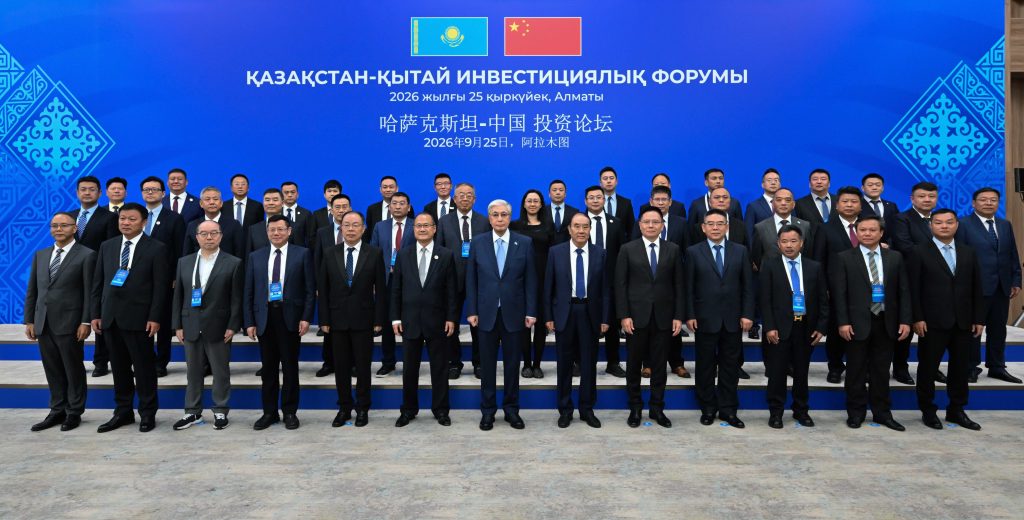
On September 25, 2026, the Kazakhstan-China Investment Forum was held in Almaty with the participation of the President of the Republic of Kazakhstan, Kassym-Jomart Tokayev. The forum brought together more than 600 representatives of business, government agencies, and development institutions from the two countries. Its results make it possible to speak not merely of an expansion of the bilateral investment agenda, but of an attempt to change the very model of economic interaction between Kazakhstan and China.
The main essence of the stated approach lies in a gradual shift from trade, infrastructure, and individual investment projects to the formation of more complex production, logistics, financial, and technological ties.
The scale of cooperation already achieved creates an objective basis for this. According to Chinese customs statistics, the trade turnover between the two countries reached $48.7 billion by the end of 2025, while Kazakhstan’s statistics estimate it at $34.1 billion. The difference is due to methodological features of foreign trade accounting. The total volume of Chinese investment in Kazakhstan’s economy over 2005-2025 exceeded $29 billion, and more than nine thousand enterprises with Chinese participation are registered in the country. The industrial cooperation portfolio today includes 260 major joint projects with a total value of more than $62 billion. Within the forum itself, 50 commercial agreements worth about $8.2 billion were signed.
However, it is precisely the scale of cooperation that is gradually changing the nature of the tasks facing both sides. For Kazakhstan, the question is no longer only how much new investment can be attracted. Equally important is what structure these investments will have, what production and competencies they will create within the country, and how deeply the Kazakh economy will be integrated into emerging value chains.
The Chinese economy is changing, and with it the content of cooperation is changing
To understand the prospects for Kazakh-Chinese interaction, it is necessary to take into account the structural processes taking place in the Chinese economy itself.
China continues to remain one of the world’s largest manufacturing economies, but the internal sources of its growth are undergoing noticeable transformation. Alongside persistent problems in the real estate sector and declining fixed-asset investment, high-tech manufacturing and equipment manufacturing are showing significantly higher rates of industrial output growth.
In August 2026, the added value of high-tech manufacturing in China increased by 16.7% year on year, and equipment manufacturing by 12.1%. The output of lithium-ion batteries and industrial robots grew especially rapidly, by 57.2% and 34.6%, respectively. At the same time, fixed-asset investment for January-August fell by 7.2%, and real estate investment by 19.9%. Such divergent dynamics clearly show the ongoing structural restructuring: traditional sources of investment growth are under pressure, while new technological and industrial segments are expanding much faster.
For Kazakhstan, this transformation has direct significance.
At earlier stages of economic relations, energy, raw material supplies, infrastructure construction, and trade naturally played a major role. These areas will retain their importance. However, the opportunities of the new stage are increasingly linked to those sectors in which China itself is now actively building up technologies and production competencies: mechanical engineering, deep processing of raw materials, new energy solutions, battery systems, digital infrastructure, artificial intelligence, and automation.
That is why further cooperation should be viewed not as a mechanical increase in the number of Chinese projects in Kazakhstan, but as an opportunity to use the changing structure of the Chinese economy to modernize individual sectors of the Kazakh economy.
From individual enterprises to production chains
One of the most substantive points of the forum was the proposal to move from implementing individual investment projects to creating full-fledged production ecosystems.
In recent years, joint projects have already gone far beyond the traditional oil and gas sector. With the participation of Chinese companies, an automotive cluster is being developed in Almaty, silicon production is being created in the Karaganda region, and projects are being implemented in metallurgy, petrochemicals, and energy storage systems. In the already emerging portfolio of agro-industrial cooperation, projects are being developed to create a vertically integrated cotton-textile cluster and to deeply process agricultural raw materials.
On September 25, the President, via videoconference, launched the construction of the Fufeng Group industrial park in the Zhambyl region. The first stage of the project provides for investments of $350 million and the creation of facilities to process up to 500,000 tons of corn per year.
Following the forum, agreements were also signed on the construction of an electrolytic aluminum plant and a related wind power plant in the Abai region, as well as on the creation of enterprises in wood processing, automotive manufacturing, the chemical industry, and renewable energy. In particular, a separate agreement provides for the joint development of a wind power project with a total capacity of up to 1 GW.
But the presence of large enterprises alone does not yet mean the formation of a production ecosystem. Such a model emerges when local suppliers, service companies, engineering organizations, logistics operators, research centers, and workforce training systems form around an anchor investor. In other words, the economic effect must extend far beyond the territory of a specific plant.
This is precisely where one of the key challenges of the next stage of cooperation lies. If components, technologies, equipment, and engineering services are mainly imported, while the Kazakh side provides primarily the site, raw materials, and labor, the economic multiplier will be limited. If, however, a network of Kazakh suppliers and specialists emerges around a major project, investments begin to form the country’s own industrial base.
Therefore, the transition to production ecosystems should be accompanied by quite measurable criteria: the share of localization, participation of small and medium-sized businesses, the volume of purchases from Kazakh enterprises, technology transfer, the creation of engineering competencies, and exports of products manufactured in Kazakhstan.
From investment volume to investment quality
A portfolio of 260 projects worth more than $62 billion makes a strong quantitative impression. However, it is precisely such a scale that makes the issue of investment quality especially relevant.
At earlier stages of relations, the size of investments naturally served as one of the main indicators of cooperation intensity. At the current stage, this criterion is no longer sufficient.
For Kazakhstan, the added value created within the country is becoming more important. From this perspective, the quality of an investment project can be assessed by at least several parameters: how deeply production is localized, whether technology transfer takes place, how many skilled jobs are created, whether local suppliers and engineering personnel are being formed, whether the enterprise is export-oriented, and how well it meets environmental and technological standards.
Resource processing is of particular importance.
Kazakhstan has significant reserves of uranium, copper, and other metals, as well as critical minerals. China, in turn, has a large industrial base for processing raw materials and producing finished goods. Such complementarity creates obvious opportunities, but at the same time raises a fundamental question about Kazakhstan’s place in the value chain.
The most economically advantageous model for the country is one in which cooperation gradually shifts from extraction and export of raw materials to processing, production of materials, components, and, where possible, finished products within Kazakhstan.
Therefore, investment interaction should be assessed not only by capital inflows. A more meaningful indicator is what share of subsequent added value Kazakhstan is able to retain within its own economy.
The Middle Corridor: from transit to economic infrastructure
Transport and logistics naturally took center stage in the forum agenda.
Over the past few years, a system of interconnected logistics hubs has in fact been formed between China and the Caspian Sea. Kazakhstan is developing terminal infrastructure from Lianyungang to Aktau, railway crossings, road routes, seaports, and border digitalization. A new element of this network is to be the Kazakh-Chinese terminal in Chengdu.
A special place is occupied by the Trans-Caspian International Transport Route, or the Middle Corridor. Its significance for China should be assessed realistically. In the foreseeable future, the Middle Corridor will not replace maritime routes, which account for the bulk of Chinese foreign trade, and should not be viewed solely as an alternative to other overland routes.
Its value lies primarily in diversification. Recent years have demonstrated the vulnerability of global supply chains to geopolitical conflicts, sanctions restrictions, logistical disruptions, and rising transportation costs. In such an environment, having several routes becomes an economic advantage in itself.
For China, the route through Kazakhstan, the Caspian Sea, the South Caucasus, and onward to Europe is an additional western direction. For Kazakhstan, its significance is potentially broader. The main task is not to be limited to the function of a territory through which Chinese cargo is transported. Transit becomes much more valuable when terminals, warehouses, processing and assembly enterprises, service companies, digital logistics platforms, and export-oriented production facilities emerge along the route.
This is where the transport agenda directly connects with the idea of production ecosystems. In the future, Kazakhstan may seek not so much to maximize the number of containers passing through its territory as to increase the economic value created around each transport corridor.
Digitalization is becoming an independent area of relations
Just a few years ago, technological cooperation occupied a noticeably less significant place in the bilateral agenda than oil, gas, trade, or transport. The forum in Almaty shows that the situation is gradually changing.
The President outlined Kazakhstan’s interest in technology transfer, the creation of joint engineering and research centers, and workforce training. An initiative to establish a Kazakhstan-China School of Artificial Intelligence in Astana is also currently being worked out. Alatau City is being considered as one of the possible platforms for technological interaction.
On the sidelines of the forum, the President held separate meetings with UBTECH Robotics, YTO Express, and Pinduoduo, during which the localization of robotics production, the development of the Almaty SkyHub transport and logistics hub, and cooperation in e-commerce were discussed.
All this suggests that technology is gradually turning from a supporting topic into a separate area of Kazakh-Chinese relations.
But it is precisely here that it is especially important to distinguish between two possible scenarios.
The first involves primarily the acquisition of ready-made Chinese technologies and digital solutions. It can modernize individual sectors fairly quickly, but it creates a limited effect for the country’s own technological base.
The second scenario is more complex, but strategically much more interesting: joint laboratories, engineering schools, research programs, specialist training, localization of technology companies, and the participation of Kazakh developers in creating and adapting solutions.
For Kazakhstan, the optimal path is precisely movement toward the second option. At the same time, technological cooperation with China should not mean technological isolation. Kazakhstan is interested in maintaining an open model that implies interaction simultaneously with Chinese, European, American, Korean, and other technological centers. Such diversification corresponds both to the country’s economic interests and to the traditional logic of its multi-vector foreign policy.
Financial infrastructure as the missing element
The financial dimension of the forum deserves special attention.
The growth in the number of major projects makes it necessary to have its own financing infrastructure. In Almaty, the creation of a Kazakh-Chinese investment fund under KAZAKH INVEST was announced. At the same time, Kazakhstan is proposing to develop cooperation between the Astana International Financial Centre and Hong Kong.
The entry of Samruk-Kazyna into China’s domestic capital market was notable: its debut panda bond issue amounted to 3 billion yuan.
This is an important change. In the previous model, most attention was focused on what project was being built and which investor was implementing it. Now another layer of interaction is gradually taking shape: who finances the projects, in what currency, in which capital markets, and using which financial institutions.
If this process continues to develop, Kazakh-Chinese cooperation may acquire a more institutional character, in which projects are supported not by individual agreements, but by permanently operating investment and financial mechanisms.
From this point of view, the proposal to hold the Almaty Investment Dialogue “Kazakhstan-China” annually is significant not only as the creation of another business platform. Potentially, it could become a mechanism for regular assessment of project implementation, removal of administrative barriers, and formation of a new investment portfolio.
The next stage: not only projects matter, but also their economic effect
The Almaty forum showed that the economic relations between Kazakhstan and China are entering a stage where simple quantitative expansion is no longer sufficient.
According to Chinese customs statistics, trade turnover has approached $50 billion, China is among Kazakhstan’s largest investors, a multibillion-dollar portfolio of joint projects has been formed, and transport infrastructure is actively developing. Consequently, the main question is gradually shifting from the scale of cooperation to its quality. For Kazakhstan, the next stage can be measured by several outcomes: first, increased depth of raw material processing within the country; second, the formation of a network of national suppliers around large foreign enterprises; third, technology transfer and the emergence of its own engineering and research competencies; fourth, the use of the country’s transport position not only for transit, but also for the development of production, logistics, and exports; fifth, the training of specialists capable of working not only in traditional industry, but also in robotics, artificial intelligence, new materials, and energy technologies.
And finally, the preservation of Kazakhstan’s economic diversification remains fundamentally important. While expanding cooperation with China, the country is simultaneously interested in developing economic and technological ties with the European Union, the United States, the countries of Asia, the Middle East, and its neighbors in Central Asia. It is precisely the combination of different directions that gives Kazakhstan the opportunity to benefit from its geographical position without turning interdependence with any one partner into excessive dependence.
Therefore, the significance of the forum should be assessed not only by the volume of signed agreements. Far more important is the logic proposed: to move from individual projects to production chains, from transit to the creation of economic value along transport routes, from technology imports to the joint development of competencies, and from counting the volume of investments to assessing their long-term effect on the Kazakh economy.
If this logic is consistently implemented in practice, the new stage of Kazakh-Chinese economic interaction will be determined not so much by the scale of China’s presence in Kazakhstan as by the depth of modernization that this cooperation helps create within the country itself.
China Studies Center