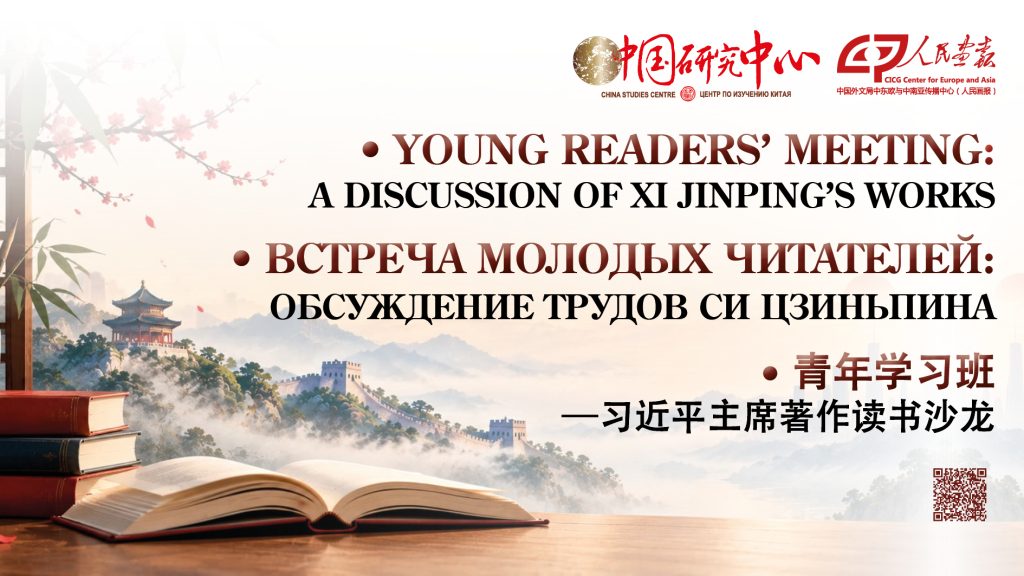
On August 6, 2026, in Astana, the China Studies Center, together with the Embassy of the People’s Republic of China in the Republic of Kazakhstan, held a seminar “The Chinese Practice of Xi Jinping’s Ideas on Party Building and Their Significance for the World”, held as part of the “Modern China: Questions and Answers” series.
The keynote address was delivered by H.E. Han Chunlin, Ambassador Extraordinary and Plenipotentiary of the PRC to the Republic of Kazakhstan.
In his report, the speaker comprehensively outlined the key provisions of Xi Jinping’s ideas on party building, their practical implementation in China, as well as the significance of this experience for understanding the logic of Chinese governance and Chinese modernization.
Particularly important is the point made that China’s experience is not a universal model to be copied. Its main value lies in each country’s ability to independently find its own path of development, based on national characteristics, the needs of society, and long-term goals. It is precisely this approach that creates a solid foundation for equal international cooperation and mutual learning from experience.
The speech by the Ambassador of the PRC to the Republic of Kazakhstan, Han Chunlin, set an important substantive direction for the seminar’s further work. During the event, the stated topic was considered from various perspectives: as a political and theoretical concept, a system of organizational management, one of the factors driving Chinese modernization, and also as a subject of professional expert dialogue between Kazakhstan and China.
For Kazakhstan, studying these issues is of practical and analytical interest. Along with the development of cooperation in the fields of economy, investment, transport, and technology, the exchange of knowledge and experience in public administration, strategic planning, personnel training, and improving the efficiency of state institutions is becoming increasingly important.
In a video address, Senior Research Fellow and former Director of the International Relations Department of the Institute of Party History and Literature of the CPC Central Committee Yang Mingwei presented a report devoted to discipline as one of the key foundations of party building. The speech showed that consistent observance of established rules, responsibility, and the inevitability of disciplinary measures are regarded as necessary conditions for ensuring the stability and effectiveness of the governance system.
In an online format, Qin Yanyang, a researcher in the Xi Jinping Thought on Culture Research Division of the Xinhua News Agency Research Institute and a member of the working group preparing the analytical report “The Characteristics of the Era and the Global Significance of Xi Jinping’s Ideas on Party Building,” joined the seminar.
In his speech, he presented a deep theoretical analysis of the origins and international significance of Xi Jinping’s ideas on party building. It was noted that this concept was formed on the basis of practical experience, the development of Marxist theory, Chinese cultural traditions, and reflection on world experience. Special attention was paid to the importance of inter-party dialogue and mutual study of national development paths.
Kairat Batyrbayev, Executive Director of the Eurasian Association of International Studies, in his speech considered party building primarily as an institutional mechanism of state governance. Special attention was paid to strategic consistency, personnel training, executive discipline, and monitoring the implementation of adopted decisions. The comparative approach presented made it possible to concretely understand common governance challenges, taking into account the differences between national development models.
Zhamaladen Ibragimov, Doctor of Law, Professor of the Department of Constitutional and Civil Law at L. N. Gumilyov Eurasian National University, presented a comparative view of the improvement of the state governance systems of China and Kazakhstan. The report identified such relevant areas as the digitalization of public services, the introduction of artificial intelligence and big data technologies, debureaucratization, strategic planning, and increasing the accountability of civil servants. It was noted that these issues are of particular practical importance for improving the efficiency of state institutions and the quality of governance.
Alibek Tazhibayev, Director of the Center for Analytical Research “Eurasian Monitoring,” presented a substantive comparative analysis of the Chinese experience of party building in the context of Eurasian governance processes. The speech noted that issues of personnel training, executive discipline, anti-corruption efforts, and ensuring effective interaction between the center and the regions are universal in nature. Of particular importance was the conclusion about the need not for mechanical copying, but for thoughtful study and adaptation of useful experience, taking into account Kazakhstan’s national conditions and characteristics.
Nurzhanat Ametbek, Associate Professor at the School of International Economics of Maqsut Narikbayev University (MNU), presented a substantive view of the interconnection between domestic governance, foreign policy, and China’s participation in global governance. The logic proposed in the report—from the development of governance capacity to the strengthening of state power, the formation of foreign policy strategy, and the expansion of international influence—creates a productive basis for further research. Special attention was paid to the role of Central Asian countries as independent and active participants in regional interaction.
Ulan Nukhitzhan, Senior Researcher at the Institute of Foreign Policy Studies of the Ministry of Foreign Affairs of the Republic of Kazakhstan, presented a substantive analysis of the topic from the perspective of Kazakhstan’s foreign policy interests. The speech noted that studying Xi Jinping’s ideas on party building is important for a deeper understanding of the logic of China’s long-term political course and the mechanisms of state decision-making. Such a pragmatic approach contributes to the further strengthening of the Kazakhstan-China strategic partnership on the basis of mutual respect and consideration of the national interests of the two countries.
In conclusion, the seminar moderator Gulnar Shaimergenova noted that the discussion demonstrated the significance of Xi Jinping’s ideas on party building not only for studying modern China, but also for a broader understanding of issues of state governance, personnel training, strategic planning, and institutional responsibility.
According to her, the speeches confirmed the value of open, professional, and respectful exchange of views based on careful study of each other’s experience and consideration of national specificities.
China Studies Center