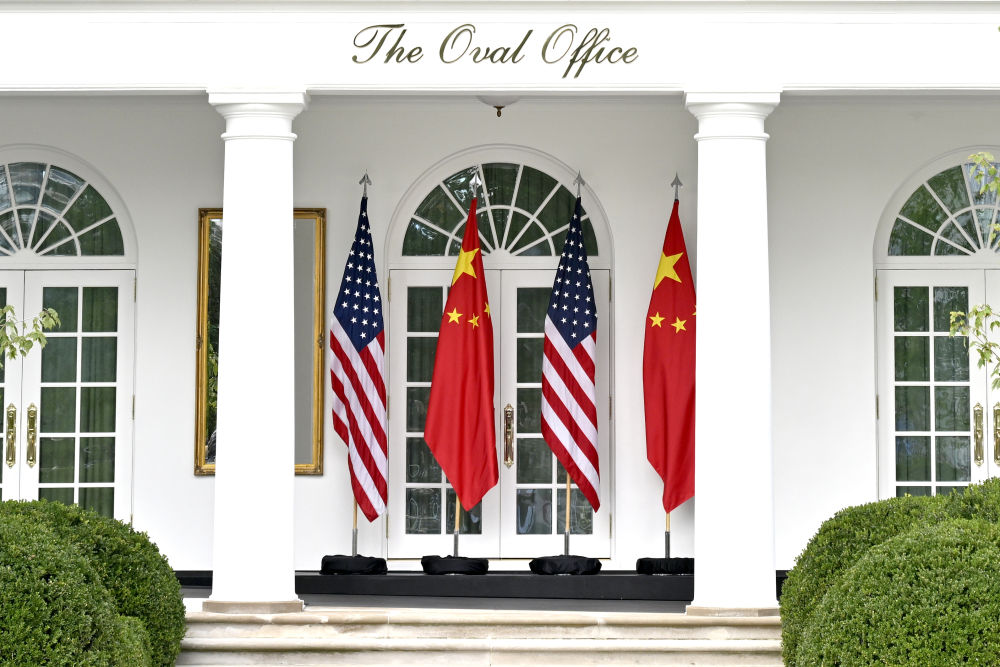
The state visit of Chinese President Xi Jinping to the United States and his talks with U.S. President Donald Trump on September 24 draw attention to an aspect of bilateral relations that often remains in the shadow of discussions about trade and technological rivalry. This concerns the attempt to identify those areas where competition between the two powers should not exclude practical engagement.
In his remarks at the White House welcoming ceremony, Xi Jinping offered a fairly vivid formula: competition between China and the United States, he said, should resemble a race in which the participants strive to outdo one another, rather than a “gladiator fight” in which one side’s defeat becomes the condition for the other’s victory. At the same time, he identified specific areas in which Beijing sees a need to preserve or expand cooperation: artificial intelligence, counter-narcotics, law enforcement, direct air links, and military crisis-communication channels.
It is precisely this list that is of analytical interest. It shows that the current stage of China-U.S. relations is gradually forming a more complex model than a simple alternation between cooperation and confrontation.
Competition does not eliminate the need to hedge risks
Security remains the most sensitive area.
Even if the strategic rivalry between China and the United States continues for the long term, both sides objectively need mechanisms that can prevent accidental escalation. During the visit, the Chinese side explicitly called for regular dialogue between the armed forces, improved crisis-communication mechanisms, and risk prevention.
This is fundamentally different from trying to eliminate military rivalry as such. Rather, it is about creating safeguards.
For relations between major powers, such mechanisms have independent value. The more complex the military and technological environment, the higher the risk of misinterpreting the other side’s actions. An incident that in ordinary circumstances might remain local can, in the absence of reliable communication channels, acquire political and strategic consequences.
Therefore, maintaining contacts between military structures should be seen not as a sign of strategic rapprochement, but as an element of risk management.
This approach is especially relevant when China’s and the United States’ interests intersect in several regions at once and simultaneously involve maritime security, new military technologies, cyberspace, and artificial intelligence.
Artificial intelligence is becoming a separate area of risk management
The second area where Washington and Beijing are trying to draw a line between competition and necessary interaction is artificial intelligence.
The United States and China are the main technological competitors in this field. But the very nature of AI creates a problem that did not exist in traditional industrial competition: the most dangerous consequences of advanced systems can extend far beyond national borders.
During the Washington talks, Xi Jinping proposed continuing dialogue on the benefits and risks of AI, preventing the misuse of technologies, and preserving human control. According to the Chinese side’s official statement, Donald Trump also said that bilateral dialogue and cooperation on artificial intelligence should continue.
Moreover, this work is already beginning to take on institutional form. The sides agreed to establish a separate formalized dialogue on AI safety and to meet again in Shenzhen in about two months. Among the mechanisms under discussion is a special communication channel for exchanging information about serious incidents in the field of artificial intelligence. If such a mechanism gains practical substance, it could become an important precedent.
In China-U.S. relations, technological competition will likely only intensify. But this does not rule out the possibility of separately agreeing on the prevention of scenarios that both sides regard as dangerous.
In a broader sense, such an approach could also be useful for the future global AI governance system: competing states do not need to have identical technological strategies in order to agree on minimum safety standards.
Counter-narcotics as an example of pragmatic cooperation
Another area highlighted during the visit is much less visible in the broader geopolitics, but it has concrete practical substance.
Xi Jinping stated China’s readiness to strengthen cooperation with the United States in counter-narcotics and law enforcement.
For the American side, the issue of drug trafficking has serious domestic political significance, above all in the context of synthetic drugs and precursors. For China, cooperation in this area makes it possible to show that even amid sharp disagreements there are problems in solving which the interests of the two countries can overlap.
Such areas are especially valuable precisely because they are oriented toward concrete results.
International relations are more stable when cooperation consists not only of broad political declarations, but also of working-level contacts between relevant agencies. Law-enforcement cooperation, the fight against transnational crime, or control over illicit chemicals can exist in parallel with disputes over trade and technology.
This does not eliminate political contradictions, but it reduces the risk that any deterioration in the overall atmosphere will automatically halt cooperation in all areas.
Direct flights as an indicator of real connectivity
At first glance, the proposal to increase the number of direct flights between China and the United States looks much less strategic than AI or military security issues.
In practice, air links are one of the most concrete indicators of the state of relations.
In his speech, Xi Jinping proposed increasing the number of direct flights, linking this both to facilitating people-to-people contacts and to developing trade and economic ties.
The number of flights affects not only tourism. It determines the conditions for business, university cooperation, scientific contacts, investment activity, and the mobility of specialists.
That is why transport connectivity can be seen as a practical indicator of how far political stabilization is truly translating into everyday interaction.
If the sides can expand air service, it will be one of those results that have a measurable effect and do not require a change in the fundamental strategic positions of the two states.
Cooperation is possible without agreement on everything
The Washington talks also showed that the sides are trying to preserve interaction on international platforms.
According to the Chinese Foreign Ministry’s official statement, the leaders reaffirmed mutual support for the successful hosting by China and the United States of major multilateral events in 2026: the APEC Economic Leaders’ Informal Meeting and the G20 summit.
This episode on its own may seem procedural. However, it shows an important feature of modern diplomacy.
China and the United States may have different approaches to the international order, trade, technology, and security, while still remaining system-forming participants in the same institutions.
Therefore, the question increasingly is not whether they can reach full agreement, but whether they are capable of maintaining a minimum level of coordination where multilateral mechanisms work much less effectively without the participation of both countries.
For the global economy, this is especially important within the G20 and APEC, where decisions by major economies affect a much wider range of states.
A new model: separating areas of interaction
This is precisely where, in our view, one of the most interesting outcomes of the current visit lies.
In China-U.S. relations, a principle is gradually emerging that can be conditionally called the functional separation of the agenda.
Where the interests of the two countries directly collide, competition remains. This applies to a number of advanced technologies, certain trade issues, and strategic security.
But there are areas where even competing powers bear too high a cost from the absence of interaction. These include preventing military incidents, artificial intelligence safety, transnational crime, transport connectivity, and certain issues of global governance.
These are the areas that require not political unanimity, but working procedures.
This model seems more realistic than expectations of a broad China-U.S. rapprochement. It is also more realistic than a scenario of complete separation.
Economic, technological, and political competition between the United States and China is too deep to disappear after a few leaders’ meetings. But the interdependence of the two states and the scale of their influence are also too great for them to interact effectively only through rivalry.
Why this matters for Kazakhstan
From Kazakhstan’s perspective, there is a broader conclusion here.
The modern international system increasingly does not allow states to divide relations into two simple categories: partnership or confrontation.
The same countries can simultaneously compete in one area, cooperate in another, and build separate risk-prevention mechanisms in a third.
For middle powers, this creates a more complex, but also more flexible, diplomatic environment.
Kazakhstan also interacts with different centers of power along different lines: trade, energy, transport, technology, security, education, and investment do not necessarily require the same political configuration of partnerships.
Therefore, the experience of the current China-U.S. talks is interesting not as a model to copy, but as an indicator of a broader change in international diplomacy: the ability to preserve functional cooperation becomes an independent value even when strategic competition does not go away.
In this sense, the most significant outcomes of meetings between the largest powers may turn out not to be the loudest statements.
Sometimes it is much more important to have a functioning crisis communication mechanism between the military, the next meeting of American and Chinese officials on AI security issues, joint work by law enforcement agencies, or an additional direct flight.
It is precisely from such practical mechanisms that the boundaries are gradually formed within which competition remains competition and does not turn into uncontrolled confrontation.
China Studies Center