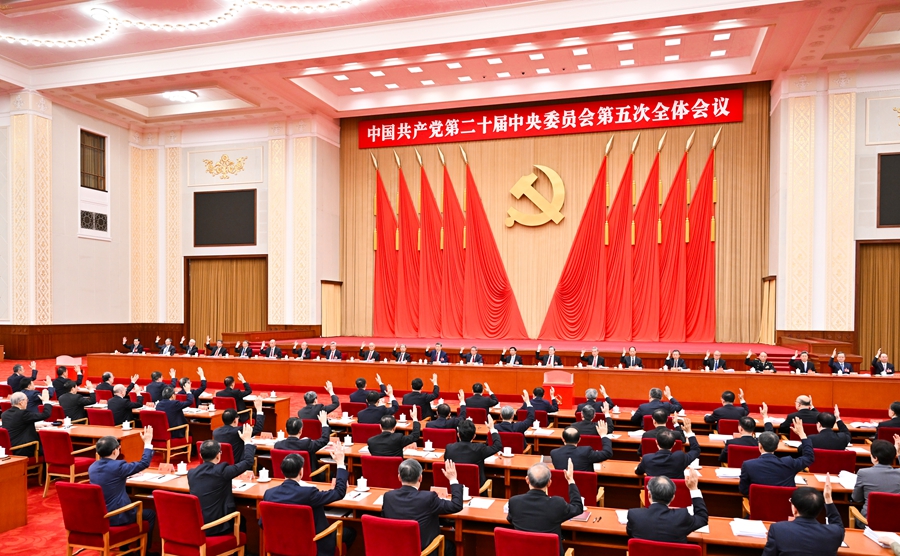
The Fifth Plenum of the 20th Central Committee of the Communist Party of China was held in Beijing on October 26-29, 2026. Its main outcome was the adoption of a decision to further strengthen “comprehensive and strict intra-party governance,” above all in matters of discipline, cadre supervision, anti-corruption efforts, and the implementation of decisions made by the party leadership. It is important to clarify this: the five-year plan for 2026-2030 was not the subject of this plenum. Recommendations for its development were adopted by the Fourth Plenum in October 2025.
The main political signal of the current plenum is that the PRC leadership views party discipline not as a separate campaign, but as a permanent instrument for governing the state and society. The document links it to the quality of officials’ work, the effectiveness of policy implementation, the stability of the system, and the party’s ability to maintain its leading role. In this logic, anti-corruption efforts, cadre policy, and strengthening control over party organizations form a single system.
From campaign to everyday system of governance
The plenum materials outline several practical directions: tightening requirements for the selection, appointment, and evaluation of cadres; improving oversight mechanisms; increasing the responsibility of party organizations; closer coordination among disciplinary bodies; and developing rules governing party activity. Special emphasis is placed on monitoring how leaders use their powers and on how consistently central decisions are implemented at the local level.
This continues the course pursued by China’s leadership since the 18th CPC National Congress, but the plenum emphasizes its institutional side. The fight against corruption should not only detect violations after the fact, but also limit the conditions that allow them to arise: reduce opportunities for abuse of power, strengthen oversight of officials, and increase the likelihood of accountability. In the official formulation, the task simultaneously covers punishment, prevention, and the formation of internal discipline.
For analysis, it is important to distinguish between the stated goal and the presumed result. Regulations and inspections can make the bureaucracy more accountable to the center and improve implementation discipline. But by themselves they do not guarantee that decisions will better reflect local conditions or that officials will be more willing to report problems upward. Stronger control can both reduce arbitrariness and push implementers toward excessive caution if the cost of error is perceived as too high.
Centralization and its governance cost
The plenum once again confirmed the priority of centralized leadership by the CPC Central Committee and at the same time called for improving procedures for intra-party discussion and decision-making. This combination reveals one of the key tasks of the current model: to ensure the uniform implementation of the line, preventing excessive autonomy among local leaders, while preserving the system’s ability to receive reliable information from below.
Such a structure can be effective when the state needs to mobilize resources quickly and coordinate the actions of regions. However, for a complex economy in which decisions affect different provinces, sectors, and interest groups, the quality of feedback is no less important than implementation discipline. If officials are guided primarily by demonstrating loyalty and formally meeting targets, a gap may emerge between central goals and the real situation on the ground.
Therefore, the effectiveness of the plenum’s decisions will depend not only on the scale of inspections and the severity of sanctions. It will also matter whether the new rules can support professional competence, proper evaluation of results, and timely identification of problems. The document itself pays attention to cadre training and the quality of governance, but the practical balance between initiative and discipline will become clear as the adopted provisions are implemented.
Anti-corruption policy and the кадровая agenda
The plenum is given special significance by the 21st CPC Congress scheduled for 2027, which was announced in the communiqué. Therefore, the provisions on cadre review, training, and appointments have not only an administrative but also a political dimension: they relate to the management of the party apparatus on the eve of the next cycle of leadership renewal. Analysts at the International Institute for Strategic Studies (IISS) also link the strengthening of the disciplinary agenda to upcoming кадровые decisions and to difficulties identified in the current oversight mechanisms.
The communiqué says that the plenum considered cases of serious violations of discipline and law involving a number of senior party and military officials and confirmed earlier decisions to expel some of them from the party. This shows the scale of attention to кадровая reliability, but it does not allow one to conclude that the problem of corruption or violations has already been solved. On the contrary, the official acknowledgment of its continuing seriousness indicates that the leadership sees disciplinary control as a long-term task.
From an analytical perspective, a dual effect of anti-corruption policy is visible here. On the one hand, it strengthens the center’s ability to control the bureaucracy, limit informal networks of influence, and increase officials’ accountability. On the other hand, prolonged inspections and high personal responsibility may increase uncertainty among managers. The quality of state decision implementation will depend on whether control can be combined with predictable procedures and professional initiative.
Significance for Kazakhstan
For Kazakhstan, the plenum is important primarily as a signal of the political and administrative environment in which PRC decisions will be made and implemented in the coming years. Stronger party control may support policy continuity, including the priorities of the 15th five-year plan. At the same time, it means that individual projects and agreements will likely be assessed more and more through their alignment with national goals, security requirements, and established procedures. Kazakh partners should take into account not only statements by Chinese agencies, but also how decisions are coordinated between the central level, provinces, and companies.
In bilateral relations, this increases the importance of specificity. When discussing investment and industrial projects, it is useful to clarify in advance timelines, responsible executors, financing conditions, localization requirements, technological cooperation, and market access. The clearer the division of obligations between the parties and the mechanisms for monitoring implementation, the lower the risk that a politically approved agreement will stall at the coordination stage or be revised during practical implementation.
Kazakhstan also needs to closely monitor how China’s course toward high-quality development and technological modernization is reflected in the structure of bilateral cooperation. In July 2026, the two sides publicly identified the digital economy and artificial intelligence, energy and mineral resources, transport connectivity, trade in services, and the expansion of direct air links among their priorities. These areas can create new opportunities, but for Kazakhstan the key issue remains the substance of cooperation: whether joint projects will develop local competencies, processing, specialist training, and access for Kazakh companies to supply chains.
For Astana, it is important to avoid two extremes: viewing the strengthening of party discipline as an automatic guarantee of China’s efficiency, or, conversely, interpreting it solely as an internal political event with no external consequences. A practical approach is to take into account the growth of centralization when assessing project timelines and risks, while also developing its own expertise on Chinese politics, regional governance, and economic planning. Kazakhstan should engage with China on the basis of mutual benefit, transparent agreements, and a clear understanding of national economic interests.
Thus, the Fifth Plenum did not announce a change in political course. It consolidated the leadership’s desire to make party control, discipline, and the fight against corruption more systematic and everyday elements of governance. The focus was not so much on new economic priorities as on the ability of the party apparatus to ensure кадровая reliability, coordinated action, and implementation of decisions.
In the near term, an important indicator will be whether the new mechanisms lead to more effective and predictable governance or increase caution within the bureaucracy. For Kazakhstan, the significance of the plenum lies in the need to understand more precisely the logic of decision-making in the PRC and to align political agreements with the practical mechanisms for their implementation. This will make it possible to build cooperation with China pragmatically, consistently, and with a clearer account of Kazakhstan’s long-term interests.
China Studies Center
(Photo by Yue Yuewei, Xinhua News Agency)