The development of artificial intelligence is reshaping the global economy, international competitiveness, and global governance. Yet states’ capacities to develop, deploy, and regulate these technologies remain highly unequal.
Access to computing infrastructure, specialist training, national data resources, and participation in international standard-setting are therefore becoming matters of broader development policy. For many developing countries, the challenge is not merely to access AI technologies, but to build the capacity to adapt, apply, and regulate them independently.
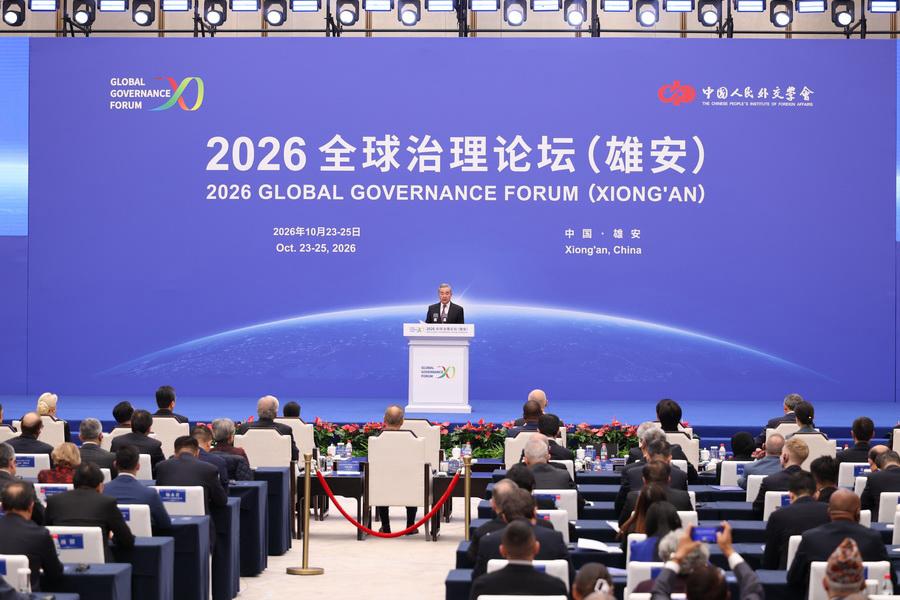
China’s approach to international AI cooperation is gradually developing into a system of policy initiatives, multilateral mechanisms, and practical programs. An important milestone was the presentation at the 2026 Global Governance Forum in Xiong’an of the Progress Report on the AI Capacity-Building Action Plan for Good and for All, prepared by the Center for Global AI Innovative Governance (CGAIG).
Published in October 2026, the report reviews the first two years of China’s AI capacity-building program. Its central argument is that reducing technological inequality requires coordinated development of infrastructure, human resources, data, applied solutions, and national governance mechanisms.
The Global AI Gap: A New Dimension of Inequality
One of the report’s key findings is that the spread of AI does not automatically reduce disparities between states. Without adequate infrastructure and institutional capacity, AI adoption may further concentrate technological and economic advantages.
According to World Bank data cited in the report, high-income countries account for 77% of global commercial colocation data center capacity, 87% of AI models, and 91% of venture capital investment in this field. Africa accounts for less than 1% of global data center capacity.
These figures illustrate differences not only in access to technology, but also in countries’ ability to develop AI systems independently.
The report identifies four principal constraints.
First, insufficient industrial and digital infrastructure. Deploying AI in agriculture, energy, transport, healthcare, and public administration requires reliable data, suitable equipment, and adaptation of existing processes.
Second, shortages of skilled personnel. Limited expertise in machine learning, data analysis, cybersecurity, and digital governance reduces countries’ capacity to develop solutions and use existing technologies effectively.
Third, unequal access to data and language resources. Advanced models generally perform better in English and other widely represented languages, while many developing countries’ languages and cultural contexts remain underrepresented in training datasets.
Fourth, limited regulatory capacity. Without expertise in risk assessment, model testing, and data protection, states risk becoming passive technology users subject to rules developed without their full participation.
The global AI gap therefore concerns not only technological availability, but also countries’ ability to shape their own digital development.
China’s Program: Five Directions and Ten Practical Actions
In September 2024, China proposed the Inclusive AI Capacity-Building Action Plan for Good and for All.
The program covers five interconnected directions: linking digital and AI infrastructure; deploying AI across economic and social sectors through the “AI Plus” approach; improving AI literacy and specialist training; strengthening data security and diversity; and ensuring the safety, reliability, and controllability of AI systems.
These priorities were developed into ten practical actions encompassing international technological cooperation, sectoral applications, green development, open platforms, education, workforce training, digital inclusion, language resources, data governance, and technological security.
The program’s distinguishing feature is its comprehensive approach to national capacity-building, based on the understanding that individual technologies cannot deliver sustainable results without supporting institutions.
For example, access to a language model cannot ensure its effective use in national healthcare without reliable medical data, trained specialists, verification procedures, and personal data protection. Likewise, data centers alone cannot create a national AI industry without scientific research, engineering skills, and demand for applied solutions.
China’s program thus seeks to move beyond transferring technologies toward developing countries’ capacity to use them independently.
From Initiative to Multilateral Mechanisms
An important component of China’s approach is strengthening the international legal and institutional framework for AI cooperation.
In July 2024, the UN General Assembly adopted by consensus the Chinese-proposed resolution A/RES/78/311, “Strengthening International Cooperation on Capacity-Building of Artificial Intelligence,” co-sponsored by 143 states.
The resolution emphasizes narrowing the AI capability gap, respecting national priorities, and expanding developing countries’ access to technologies and knowledge.
In December 2024, China and Zambia convened the first meeting of the Group of Friends of International Cooperation on AI Capacity-Building at the UN. This mechanism supports ongoing dialogue among governments, international organizations, academic institutions, and technology companies, helping connect developing countries’ needs with available financial, technological, and educational resources.
Another institutional development was the establishment of the World Artificial Intelligence Cooperation Organization (WAICO).
According to the report, its establishment ceremony took place in Shanghai on July 16, 2026, with Kazakhstan among the initial signatories. The number of founding states subsequently reached 38. Headquartered in Shanghai, WAICO is intended to facilitate international cooperation, technology exchange, and approaches to safe and equitable AI development.
For Kazakhstan, participation offers opportunities to access expert networks, contribute to standards discussions, and develop joint technological projects. However, WAICO’s effectiveness will depend on its institutional structure, financing, participants’ commitments, and equal participation in decision-making.
Open Technologies as a Tool for Reducing the Digital Divide
Open models and software are central elements of China’s program, intended to expand developing countries’ access to AI technologies.
One example is FlagOS, developed with the participation of the Beijing Academy of Artificial Intelligence, leading universities, and computing hardware manufacturers.
Designed to adapt and deploy AI models across different computing devices, FlagOS supports hardware from 21 manufacturers and enables deployment of more than 90% of common open large models across various hardware platforms. According to the report, it has approximately 200,000 users.
Such solutions can reduce dependence on particular hardware architectures and lower computing costs, potentially expanding opportunities for countries with limited access to advanced processors.
However, open source alone does not eliminate technological dependence. Effective implementation still requires local development teams, computing resources, sustainable financing, and independent security assessment.
Openness should therefore be regarded as a tool for gradually strengthening technological independence, rather than a guarantee of it.
Practical Projects: From Transport to Disaster Warning
The report presents ten thematic examples of China’s AI capacity-building program, including projects addressing specific economic and social challenges.
In transport, it describes cooperation between Huawei and South Africa’s Passenger Rail Agency (PRASA), involving big data and DeepSeek models to improve railway operations, maintenance, and information systems.
According to the report, AI increased information retrieval efficiency by more than 90%, while operating and maintenance costs are expected to decline by at least 30%. Importantly, the latter figure is a forecast, not an achieved result.
Another example is MAZU, an early-warning system developed by the China Meteorological Administration. It integrates forecasting, risk analysis, and public alerts.
The report states that MAZU has been implemented in eight countries, while its cloud-based version is used in more than 50 states.
Such systems are relevant to Central Asia, where floods, droughts, mudflows, and other natural hazards present significant risks. Their effectiveness, however, depends on integration with national hydrometeorological services, civil protection institutions, and emergency response mechanisms.
The report also examines ScienceOne, an AI model developed by the Chinese Academy of Sciences to support scientific analysis, alongside international training programs for researchers from developing countries.
These cases illustrate the transition from general technological cooperation toward specialized solutions addressing practical industrial, scientific, and social needs.
Language Diversity and Digital Sovereignty
The report also addresses language diversity and the preservation of cultural identity.
Large language models depend heavily on extensive digital corpora. Languages with insufficient representation in training datasets may face unequal access to high-quality AI services.
One example is Laos’s national large language model, developed using Chinese technologies and adapted to the national language, local culture, and users’ practical needs.
This experience is relevant for Kazakhstan. Developing effective Kazakh-language models requires not only more digital texts, but also reliable procedures for data selection, annotation, licensing, and evaluation.
National universities, research institutions, technology companies, and public authorities can contribute to this work. At the same time, language model development forms part of the broader task of digital sovereignty.
Digital sovereignty involves the capacity of national institutions to determine data-use conditions, protect information systems, and develop technologies suited to public needs.
International cooperation, including with Chinese partners, can support these objectives while preserving national control over critical data and complying with domestic legislation.
Artificial Intelligence Safety and the Right to Development
China’s approach treats AI safety and development as interconnected priorities.
The report identifies risks including algorithmic discrimination, privacy violations, misinformation, and insufficient transparency in automated decision-making. Developing countries often lack the resources and expertise to assess these risks independently.
An important conclusion is that international safety mechanisms should not become additional technological barriers limiting the Global South’s participation in AI development.
China proposes combining safety requirements with wider technological access and stronger national regulatory capacity. This reflects the broader understanding that participation in technological development is increasingly connected to the realization of the right to development.
Achieving this balance remains challenging. Excessive restrictions may limit access and increase market concentration, while insufficient regulation threatens personal data, public safety, and critical infrastructure.
International cooperation should therefore include comparable risk-assessment procedures, technical testing, independent auditing, and exchanges of regulatory experience.
Four Conclusions from Two Years of Program Implementation
Drawing on the program’s implementation experience, the report identifies four principal conclusions.
First: access to technology is the starting point, while independent development is the ultimate goal. Cooperation should build national competencies rather than merely supply ready-made solutions.
Second: projects should reflect recipient countries’ actual needs. Effectiveness requires joint needs assessment, participation of local institutions, and adaptation to national conditions.
Third: data, models, personnel, and governance mechanisms must develop together. Weakness in any component constrains the entire system.
Fourth: openness and open-source technologies support inclusive development. They reduce entry barriers but require complementary infrastructure, education, and institutional capacity.
Together, these conclusions position China’s program as more than technological assistance: it represents an attempt to develop a broader model of international cooperation in AI.
Kazakhstan and Central Asia: Possible Areas of Cooperation
For Kazakhstan and Central Asia, the program is particularly relevant to developing independent technological capabilities.
The region has opportunities to expand AI applications in transport, energy, agriculture, education, public administration, and environmental monitoring. Realizing this potential requires coordinated investment in infrastructure, skills, data resources, and national regulation.
Five areas of cooperation appear especially promising.
First, regional cooperation in computing infrastructure. Joint research platforms, open models, and technical exchanges could reduce the costs of developing AI applications. Such projects must also address information security, energy supply reliability, and national data protection requirements.
Second, specialist training and joint educational programs. Cooperation between Kazakhstani and Chinese universities could expand in data analysis, machine learning, robotics, the digital economy, and AI regulation. Training should cover not only developers, but also professionals capable of assessing the economic, legal, and social consequences of AI deployment.
Third, development of national language resources. Joint research could improve Kazakh-language processing, specialized datasets, and models for education, science, and public services. National research institutions should participate in defining project architecture, data requirements, and quality assessment methods.
Fourth, AI applications in transport and energy infrastructure. As a major transit country, Kazakhstan could apply intelligent systems to freight forecasting, infrastructure maintenance, logistics optimization, and energy efficiency. China’s experience in sectoral AI deployment could complement existing transport connectivity projects.
Fifth, stronger technological risk management and assessment. Kazakhstan needs national expertise in algorithm auditing, data protection, model testing, and regulation in sensitive sectors. International organizations and expert platforms can facilitate knowledge exchange, but cannot replace domestic regulatory and research capacity.
Joint pilot projects with clearly defined performance indicators could become particularly valuable. These might measure operating cost reductions, productivity gains, improved access to public services, local workforce development, and use of national technological resources.
Measurable outcomes are essential for assessing the real benefits of international cooperation.
From Technological Access to Independent Development
The report presented in Xiong’an reflects an important feature of China’s approach to global AI governance: linking technological progress with international equity, digital sovereignty, sustainable development, and states’ participation in shaping common rules.
Rather than relying solely on declarations, China proposes practical cooperation through the UN, specialized international organizations, educational initiatives, and technological platforms.
Nevertheless, assessing the program’s effectiveness will require more systematic evidence of actual outcomes.
The report’s examples demonstrate the potential of particular technologies and cooperation models, but their results cannot automatically be generalized across countries and sectors. Objective evaluation requires comparable data on project costs, operational sustainability, skills transfer to local organizations, data security, and long-term socioeconomic effects.
For Kazakhstan and Central Asia, international technological cooperation should primarily strengthen national scientific, engineering, and managerial capacities.
Beyond accessing advanced AI models, national institutions must be able to adapt them to local conditions, assess associated risks, and demonstrate practical benefits.
Thus, the central question of global artificial intelligence governance is not only who develops the most advanced technologies, but also what opportunities other states have to independently participate in their development, application, and regulation.
The capacity of international mechanisms to ensure such participation will be a key measure of their effectiveness as AI continues to transform the global economy.
China Studies Center