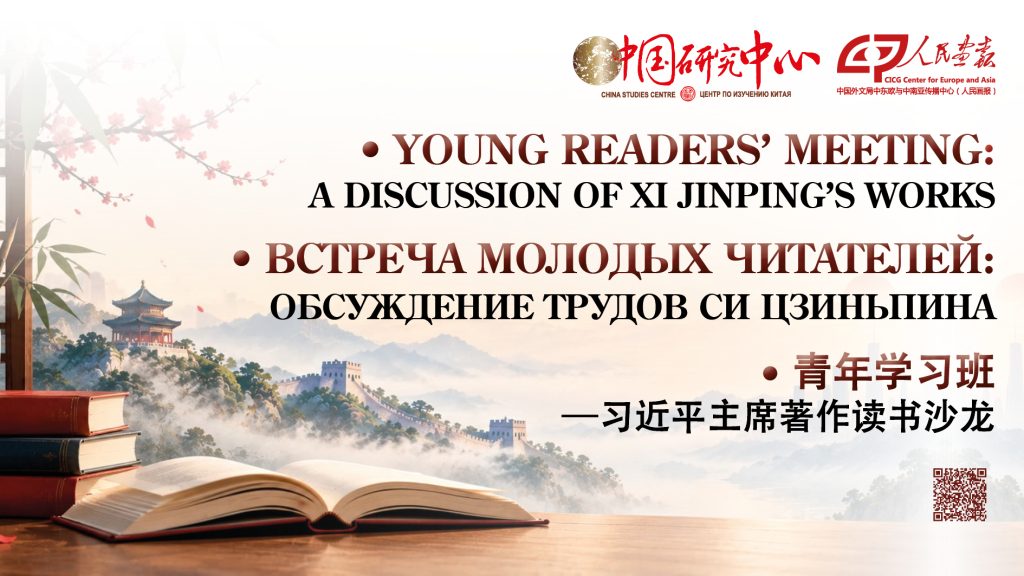
On October 2, 2026, Maqsut Narikbayev University hosted a youth seminar, “Young Readers’ Meeting: A Discussion of Xi Jinping’s Works” / Young Readers’ Meeting: A Discussion of Xi Jinping’s Works. The event was organized by the China Studies Center (Kazakhstan) and the CICG Center for Europe and Asia. The meeting focused not only on the texts themselves and the concepts set out in the works of the President of the PRC, but above all on how they are perceived by a new generation in Kazakhstan.
The seminar’s distinctive feature was its youth format. The main speakers were students, master’s students, doctoral candidates, and young researchers. Instead of the traditional sequence of academic presentations, the discussion was built around specific questions about Chinese modernization, governance, Kazakhstan-China relations, education, technology, artificial intelligence, language, academic exchanges, and personal experience of getting to know China. The program was divided into two panels: “Modern China Through the Eyes of the Young Generation: Modernization, Governance, and Relations with the World” and “Education, Technology, and Youth: From Ideas to Personal Experience of Cooperation.”
Opening the meeting, the director of the China Studies Center, Gulnar Shaimergenova, noted that the seminar continues introducing the Kazakh audience to Xi Jinping’s works, but shifts the discussion into a fundamentally different format, where young readers are given the floor. In her words, it is important not merely to become acquainted with the ideas of a political leader of another country, but to understand how that country itself explains its development path, what tasks it considers priorities, and what future it envisions for itself. For Kazakhstan’s youth, China is already part of their immediate educational and professional environment through academic exchanges, technology, international relations, economic projects, language learning, and contacts between universities.
The organizers deliberately rejected an approach in which young participants are asked only to reproduce ready-made formulations. On the contrary, the main task was to compare ideas with real processes and with their own experience. In the seminar’s conclusion, the China Studies Center emphasized that the value of such meetings lies precisely in developing an independent professional perspective: reading different sources, studying China directly, taking advantage of exchange opportunities, learning languages, and asking difficult questions.
Youth as a Key Link in Kazakhstan-China Interaction
Yu Shanshan, deputy head of the Europe and Asia Broadcasting Center of the People’s Daily Press under the State Administration of China for the Publication and Distribution of Literature in Foreign Languages, delivered a detailed video address to the participants. She linked the discussion of the fifth volume of Xi Jinping on State Governance with the broader theme of the development of China-Kazakhstan relations and the role of youth in strengthening ties between the two societies. According to her, the expanding cooperation between the two countries creates a space in which the ideas of mutual respect, dialogue, and interaction acquire practical meaning.
The first principle Yu Shanshan focused on was mutual respect. She outlined the Chinese approach, according to which differences in historical traditions, cultures, and development models should not become grounds for hierarchy between states or civilizations. In this context, China-Kazakhstan relations were presented as relations between neighboring states that, despite their own specific features, can develop trust and cooperation on the basis of equality. She also linked this principle to youth contacts: sustainable mutual understanding between societies, she said, begins with the ability of the new generation to perceive another country without prejudice and with respect for its particularities.
The second part of her speech concerned the interconnection of peace, security, and development. Yu Shanshan outlined the Chinese understanding of common, comprehensive, cooperative, and sustainable security and emphasized that a stable regional environment is seen as a necessary condition for education, professional growth, and self-realization of young people. Thus, security issues in her speech were taken beyond a purely political agenda and also presented through a human dimension: the opportunities for young people to study, work, travel, and realize their plans directly depend on a peaceful and predictable regional environment.
Humanitarian cooperation occupied a special place in the address. Yu Shanshan recalled the development in Kazakhstan of Luban Workshops, Confucius Institutes, Chinese university projects, academic mobility, and mutual travel after the introduction of the visa-free regime. The main emphasis was placed not on the number of mechanisms, but on people-to-people contacts. She cited Xi Jinping’s statement that the key to bringing peoples closer lies in youth communication, and expressed hope that young Kazakhstani people would take a more active part in educational and humanitarian exchanges. In this logic, youth diplomacy effectively becomes a long-term resource for bilateral relations: state agreements create the framework for cooperation, but the sustainability of ties depends largely on how well future generations know and understand one another.
Chinese Modernization, Governance, and the External Environment
The first panel was opened by Altyniya Gazizova, a master’s student in the Political Science and International Relations program at Maqsut Narikbayev University. She examined Chinese governance from the perspective of political science and drew attention to the mechanism of moving from a long-term strategic goal to concrete public policy. In her presentation, this system was described as a sequence of three levels: long-term vision, five-year planning, and practical implementation at the level of institutions and territories. In this way, the discussion of Chinese modernization was shifted from general formulations to the question of how major goals become measurable policy decisions.
At the same time, Altyniya suggested not idealizing the mere existence of long-term plans. From a research perspective, she called the space between the announced goal and the actual result the most interesting. Differences in resources, institutional capacity, and the motivation of local authorities can affect how central directives are implemented in practice. In her view, it is precisely the analysis of this “implementation gap” that allows a young political scientist to move from reading official plans to a deeper understanding of governance. She also linked this approach to her academic interests, emphasizing the universality of the question of how political commitments turn into real social outcomes.
Igor Skorokhod, an expert at the Heartland analytical center and a master’s student at L.N. Gumilyov Eurasian National University, examined Kazakhstan-China relations in the context of a changing international environment. He identified two simultaneous processes: the intensification of geopolitical and technological competition, the fragmentation of the global economy, and changes in trade routes on the one hand, and the growing importance of Central Asia for Eurasian connectivity on the other. As an indicator of the scale of interaction, he cited trade statistics between Kazakhstan and China, separately drawing attention to differences between Chinese and Kazakh methods of accounting. This methodological comment was important in itself: the young researcher showed that analyzing bilateral relations requires not only big numbers, but also critical work with sources.
In substantive terms, Igor linked Xi Jinping’s ideas with concepts such as the interdependence of development and security, multilateralism, and regional connectivity. However, the most applied part of his speech consisted of four areas where, in his view, Kazakhstan and China need deeper mutual understanding: transboundary water resources and ecology, transport and economic added value, technology and artificial intelligence, and the mutual perception of societies. The last aspect is especially important for the new generation of China specialists: Kazakhstan needs to better understand China’s internal mechanisms, while Chinese partners need to take into account public expectations, the multi-vector nature of foreign policy, and Kazakhstan’s national priorities. He defined the role of young researchers as the ability to work with sources from both countries and translate political concepts into an analytical language understandable to each other.
Samat Daulenov, a third-year International Relations student at MNU, presented Chinese modernization as a multidimensional process that cannot be reduced to economic growth rates. In his presentation, modernization was considered through the specifics of China’s historical experience, political institutions, cultural traditions, and the country’s enormous scale. He separately highlighted the characteristics that Chinese political thought attributes to its own model of modernization: development in a country with a large population, the pursuit of common prosperity, the combination of material and cultural-ethical progress, harmony between humanity and nature, and a commitment to a peaceful path of development.
Samat explained the practical meaning of such a view through several interconnected dimensions: industrial and technological development, education and healthcare, social values, the effectiveness of state institutions, and ecological transformation. In his speech, he compared economic, social, and environmental indicators in an effort to show that the concept of modernization in Chinese discourse serves as a general framework for the transformation of the economy and society. For an international relations student, this approach is also important because the foreign policy of a major power becomes clearer when its internal development goals are analyzed.
The presentation by Altair Sandybek, a third-year International Relations student at Maqsut Narikbayev University, was especially personal. Unlike the conceptual reports, he spoke about his own experience of traveling to China. Before that, his impressions had been shaped largely by mass media and social networks: China seemed overcrowded to him, and difficult in terms of language and everyday environment. His exchange study experience in Dalian and his trip to Beijing changed that image. He was impressed by the organization of public transport, the convenience of urban infrastructure, digital services, technological achievements, and everyday university life.
But the main conclusion of his story was not an assessment of infrastructure, but the importance of direct human contact. Altair spoke about everyday communication with Chinese students and ordinary residents, about people trying to help a foreigner even with a language barrier, and about small episodes that give more understanding of a country than a distant informational image. The essence of his speech was expressed in a simple formula: stereotypes arise at a distance, understanding is formed through contact. In the context of Kazakhstan-China relations, this turned academic exchange from an educational program into a tool of social mutual understanding.
Rauana Aubakirova, a young Oriental studies researcher at L.N. Gumilyov Eurasian National University, continued this theme from a research perspective. In her observation, the perception of China among Kazakhstani youth is not uniform. On the one hand, China is associated with economic development, technology, education, and expanded opportunities for study and professional growth. On the other hand, some perceptions are still shaped by broad images of China’s global economic and political role, without a deep acquaintance with the structure of modern Chinese society and the everyday life of Chinese youth.
Rauana cited data showing an increase in the number of Chinese students at Kazakhstani universities and linked the expansion of educational mobility with a gradual change in mutual perceptions. She identified direct communication with peers, especially within study and university exchanges, as the strongest factor. Social networks make it possible to see the everyday life of another country more quickly, but they do not always provide systematic knowledge. Therefore, in her view, the most sustainable effect arises where education, travel, academic mobility, and personal contacts are combined.
The first discussion ultimately showed an important shift in the nature of youth conversation about China. For the participants, it is no longer limited to the question of whether China is primarily Kazakhstan’s economic partner. Young researchers view it simultaneously as an object of political science analysis, international interaction, educational experience, and direct human acquaintance. This approach makes perception more complex, but that complexity is precisely what is needed for professional China studies.
From Educational Openness to Practical Skills
The second panel was opened by Mamyr Altaybek, head of the Luban Workshop and a doctoral candidate at L.N. Gumilyov Eurasian National University. He linked the theses on educational openness presented in the fifth volume of Xi Jinping on State Governance with a specific Kazakhstani case. The central example was the Luban Workshop at ENU. In his definition, it is not a symbolic presence of international partnership, but a physical educational infrastructure that allows students to work with robotics, automation, and digital systems directly in the learning process.
Mamyr proposed a clear formula for the development of such cooperation: infrastructure leads to the formation of skills, and skills create the basis for joint tasks. The next stage, in his view, can be applied research, projects with enterprises, and joint technological developments. For a student, the practical value of the Workshop lies in three things: the opportunity to work with real equipment, to be in an international educational environment, and to shape a future professional trajectory. In this way, educational cooperation ceases to be a separate humanitarian sphere and becomes one of the channels of technological interaction between Kazakhstan and China.
Alina Shchetinina, a third-year International Relations student at Maqsut Narikbayev University, focused on the interconnection of education, science, technology, and talent development. Starting from this line in Xi Jinping’s works, she posed a practical question: is it enough for a modern university to pass academic knowledge to a student, or must its task also be to teach how to turn knowledge into solutions, technologies, and projects? For Kazakhstan, in her view, this issue is directly linked to economic diversification and the transition to more technological and knowledge-intensive industries.
As examples, Alina referred to exchanges of young engineers between China and Central Asia and cooperation in the field of artificial intelligence. Her main conclusion was the need for a closer connection between three levels: research, technology, and commercialization. University education in such a model should form not only the ability to understand existing knowledge, but also the ability to bring a research idea to a practical product, business, or technological solution. She saw this as one of the most relevant points of convergence between Kazakhstan’s educational agenda and China’s experience of innovative development.
Adilbek Aisultan, a second-year Applied Linguistics student at MNU, suggested looking at Kazakhstan-China cooperation through a completely different lens: language in the era of artificial intelligence. He raised a question that is becoming increasingly relevant for future linguists: if neural networks can translate texts and speech almost instantly, is there still a need to study foreign languages deeply? His answer was the opposite of what might be expected. The more advanced machines become, the more important, in his view, human understanding of context, subtext, emotional nuance, and cultural codes becomes.
In this context, Adilbek linked the ideas of dialogue and mutual learning between civilizations with the real possibilities of the digital age. He proposed developing specialized language tools and parallel corpora for Kazakh, Chinese, and Russian, joint student digital communities, and projects at the intersection of linguistics and information technology, including Natural Language Processing. Artificial intelligence, therefore, does not eliminate the need for a linguist, but changes their function: from a mechanical translator of words to a specialist capable of creating conditions for more accurate intercultural understanding.
The second panel discussion was concluded by Bulat Mukanov, a fourth-year student at L.N. Gumilyov Eurasian National University and a participant in international educational exchanges and conferences. His presentation, “A China Specialist from ENU’s Stories,” was a kind of return from big concepts to personal experience. In his account, China unfolded in several dimensions at once: as a place of study in business analytics, logistics, finance, and international trade; as an environment for learning Chinese language and culture; and as a space for everyday acquaintance with traditions and ways of life.
An equally important result of international mobility for him was the expansion of his human circle of communication. Among the experiences he gained, he separately highlighted meeting students from Colombia, Saudi Arabia, Canada, France, Algeria, Myanmar, and other countries, as well as new sports interests. This example showed the broader effect of studying abroad: a trip to China becomes not only a way to better understand China itself, but also an opportunity to join an international student environment, test one’s independence, acquire new skills, and form connections that can influence one’s future educational and professional trajectory.
From Reading to Independent Understanding
The seminar’s overall substantive result was that Xi Jinping’s works were considered not in isolation, but as one of the sources for understanding how modern China describes its own development priorities. Chinese modernization was discussed simultaneously through state planning, economic transformation, education, technology, ecology, and social development. Foreign policy concepts were correlated with specific issues of Kazakhstan-China interaction, from transport and technology to ecology and youth contacts.
At the same time, the most notable feature of the meeting was the combination of analysis and personal experience. Young researchers spoke about the mechanisms of public policy implementation and the transformation of the international environment, while students supplemented this conversation with observations from trips, university exchanges, language learning, and work with new technologies. As a result, the discussion of China moved beyond two extremes: uncritical acceptance of official discourse on the one hand, and superficial perceptions of the country on the other. The conversation was grounded in knowledge, sources, professional questions, and direct experience.
For Kazakhstan’s expert community, such a format has special significance. As economic, educational, and technological ties with China expand, the need grows not only for specialists who know the Chinese language, but also for people capable of understanding China’s governance system, economic processes, society, and culture, while at the same time having a strong grasp of Kazakhstan’s national interests and specific features. In this regard, youth academic exchanges should be seen not as a peripheral humanitarian direction, but as one of the mechanisms for forming the future professional infrastructure of bilateral relations.
In conclusion, the organizers emphasized that the purpose of such meetings is not to form a single view of China. On the contrary, the younger generation needs to read, compare sources, analyze ideas, see the differences between declared concepts and their practical implementation, and form its own conclusions. It is precisely the ability to understand one another professionally, while preserving independent judgment and a national perspective, that can become one of the most sustainable resources for the further interaction between Kazakhstan and China.
China Studies Center