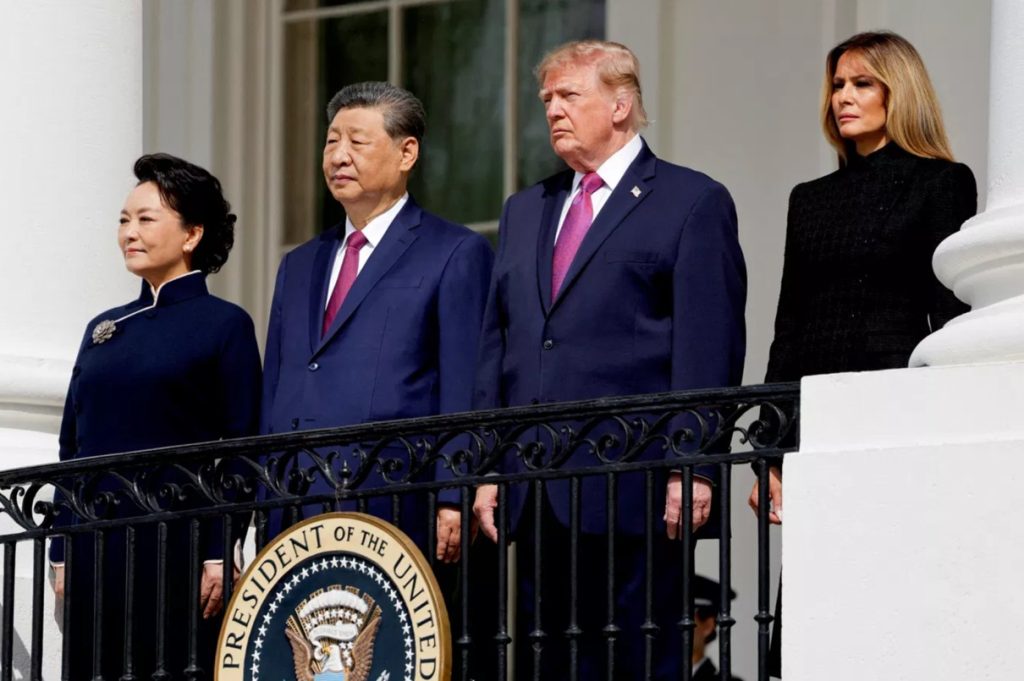
The Washington visit should be viewed first and foremost as a stage in the institutional consolidation of the agreements reached earlier in Beijing. Its significance lies not in the formation of a fundamentally new model of China-U.S. relations, but in clarifying the political framework within which the two sides intend to manage strategic competition, maintain working channels of interaction, and translate the agreements reached at the highest level into more durable mechanisms.
In this sense, the meeting between Xi Jinping and Donald Trump showed a shift in bilateral relations toward a more structured format: competition remains, but the sides seek to limit its destabilizing effect through clearer principles, regular communication, and practical cooperation where their interests overlap.
During the final meeting on September 25, the heads of state agreed to further flesh out the substance of the China-U.S. relationship formula and jointly build a relationship of constructive strategic stability based on respect, fairness and equality. In the official English-language version of the PRC Foreign Ministry, the formula used is respect, fairness and reciprocity.
This clarification deserves special attention. It shows that after several months of intensive contacts, the sides are trying to move from a general principle of stabilizing relations to a more specific set of political guidelines that should govern interaction under conditions of ongoing competition.
The political framework has become more specific
In May, the sides agreed to build a relationship of constructive strategic stability. The Washington visit added a clearer understanding of the principles on which this formula should rest.
The Chinese side emphasizes three elements: respect, fairness and equality. At the same time, the earlier approach remained in place during the talks, according to which cooperation should remain the main direction of the relationship, competition should be kept within certain bounds, and disagreements should not escalate into uncontrolled confrontation.
In essence, this is an attempt to create rules of conduct within a competitive relationship.
This matters because China and the United States have not eliminated their fundamental differences. But the current visit shows both sides’ desire to create a political construct in which the existence of disagreements should not automatically destroy other areas of interaction.
That is why it is more appropriate to assess the outcome of the visit not by asking whether strategic rapprochement took place. It did not, and the visit materials do not indicate that it did. A more precise question is different: has a clearer framework emerged for managing inevitable contradictions? The Washington meeting provided some grounds to say that it has.
The implementation of agreements becomes important
In the final materials of the visit, the idea of translating political agreements into practical actions is repeatedly emphasized.
Xi Jinping noted that trade and economic consultations produced mutually beneficial results. During the talks on September 24, he also stated that the new round of consultations had ended with a new joint agreement, which the Chinese side views as a positive outcome for business, the citizens of both countries, and the global economy.
At the same time, the logic of the visit itself shows that the task of the sides now lies less in formulating new common principles than in implementing the agreements already reached. This is where the main test of the resilience of the current political framework will take place.
A high level of personal contact between leaders can set the direction, but the long-term effect depends on whether the relevant agencies, economic teams, companies, and other participants in bilateral interaction can turn political guidelines into workable solutions. In this sense, after the visit ends, a stage begins that is no less important than the summit itself.
The economy remains the main indicator
A separate place in the visit materials is occupied by the position of American business.
The president of the U.S.-China Business Council, Sean Stein, emphasizes that American companies continue to highly value the Chinese market and are interested in further cooperation with Chinese enterprises. His argument is interesting because it goes beyond a simple assessment of the size of the Chinese market. Stein links a presence in China to access to technological innovation, industrial chains, and the ability to increase the global competitiveness of American companies.
Thus, the economic interdependence of the two countries retains a more complex character than a simple exchange of goods. For business, the main issue is not only trade volumes, but also the predictability of the political environment. That is why the stability of bilateral relations is seen by the business community as an independent economic value.
This once again shows that the consequences of China-U.S. political decisions extend far beyond diplomacy.
The symbolism of the final day of the visit
An interesting element of the program was a visit to the U.S. National Archives after tea at the White House. Xi Jinping spoke about the differences between the history, culture, social system, and development paths of China and the United States, while also emphasizing that the peoples of both countries share a common aspiration for a better life. He linked the long-term sustainability of relations to recognition of differences, mutual respect, and the search for the broadest possible area of overlapping interests.
This episode well reflects the broader idea of the visit. The Washington meeting was not an attempt to prove that the two countries are similar. On the contrary, differences were openly acknowledged. The political task was formulated as finding a model of coexistence precisely while preserving those differences. In current conditions, this may be a more realistic basis for bilateral relations than expecting a fundamental convergence of political systems or strategic interests.
The significance goes beyond bilateral relations
The materials summarizing the visit repeatedly stress that the consequences of China-U.S. relations extend far beyond the two states.
During the talks, the sides discussed international and regional issues and reaffirmed mutual support for the successful holding by China and the United States of major multilateral events in 2026.
But something else is even more important. When relations between the two largest economies become more predictable, this affects not only Beijing and Washington. It changes the expectations of businesses, investors, and states that interact with both countries at the same time.
That is why many experts featured in the visit materials link the stability of China-U.S. relations with broader stability in the international economic environment.
Here, however, analytical caution is necessary. One state visit does not eliminate accumulated structural contradictions. It is more accurate to speak of creating conditions under which these contradictions can be managed more systematically.
What this means for Kazakhstan and Central Asia
For Kazakhstan and other Central Asian countries, the significance of the visit’s outcomes lies primarily in the fact that China-U.S. relations directly affect the international environment in which the region builds its own foreign economic and foreign policy ties.
Central Asian states are simultaneously interested in access to Chinese markets, investment, and infrastructure opportunities, as well as in cooperation with the United States and other Western partners in the areas of investment, technology, education, and international institutions. Therefore, it is fundamentally important for the region that competition between the major powers does not take a form in which cooperation with one side automatically limits interaction with the other.
A more predictable China-U.S. competition potentially expands the space for an independent foreign policy for Central Asian countries. It reduces the risk of abrupt external restrictions on trade, investment, and transport projects and allows the states of the region to continue building relations with different partners based on their own national interests.
For Kazakhstan, this is especially important from the standpoint of the multi-vector approach. The more institutionalized and manageable relations between major centers of power become, the more room remains for pragmatic cooperation in several directions at once without having to turn economic interaction into a political choice between the sides.
At the same time, Central Asia needs not only to observe China-U.S. relations, but also to take their changes into account in its own strategic planning. Decisions by Beijing and Washington in trade, technology, and global governance can indirectly affect investment flows, supply chains, and the region’s conditions for participation in international projects.
Washington after the visit
The concluded visit showed that the sides are not yet seeking to resolve all contradictions in China-U.S. relations at once. Instead, a more limited and pragmatic task is gradually taking shape: to establish principles, procedures, and political guidelines that will allow the two largest powers to compete without completely destroying the space for interaction.
The appearance in the final formula of the concepts of respect, fairness and equality shows an attempt to give this model a more definite normative basis.
Now the main criterion will be practice. If the agreements reached are consistently implemented at the level of agencies, economic teams, and specific areas of cooperation, the Washington visit may become an important stage in the institutionalization of China-U.S. relations.
If, however, the political formulas remain mostly at the level of statements, their stabilizing effect will be limited.
Therefore, the significance of the visit that concluded on September 25 will ultimately be revealed not in the ceremony itself, nor even in the number of announced agreements, but in how durable the mechanisms created will prove to be after the leaders return home.
China Studies Center